

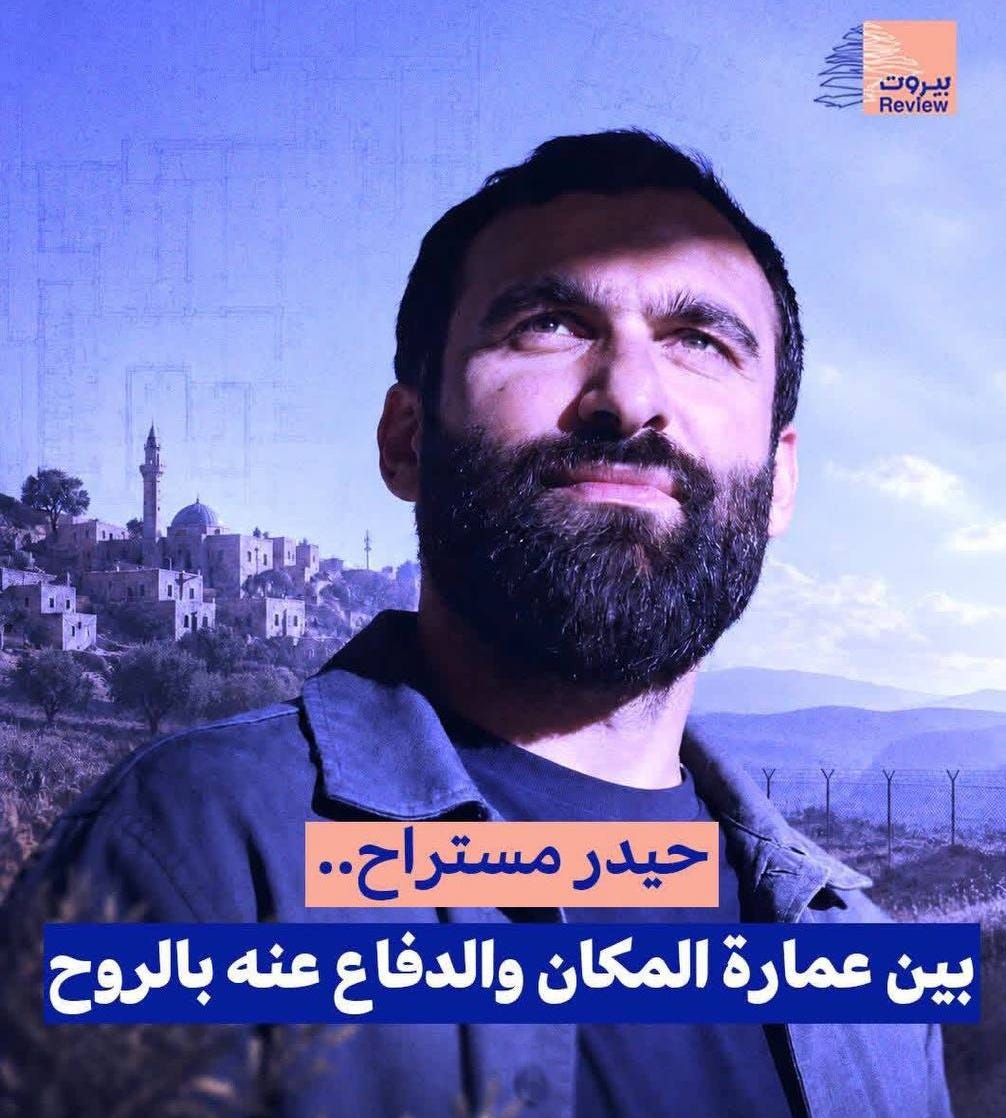
“Today, as before, you are the master, Haidar, and we are your imperfect students.”
This singular phrase lingered heavily amidst the many tearful farewells, echoing a sentiment shared by all who knew him. In the testimonies left behind, a unified portrait emerges: Haidar Mustarah was remembered first and foremost as a generous soul—a well-read, deeply present conversationalist, and a steadfast friend who always showed up when he was needed most.
The Architect of Memory
Months before his martyrdom, Haidar—a gifted Lebanese architect and specialist in urban sociology—penned a profound article in the newspaper Al-Akhbar. Looking at the devastation of war in southern Lebanon, he refused to merely tally the destroyed buildings. He was searching for something far deeper.
Haidar mourned the public squares where communities gathered, the mosques that anchored village histories, and the narrow alleyways where generations had grown up. To him, a place was never just geography; it was the living vessel of its inhabitants’ identity. He believed that the destruction of these spaces went far beyond moving stones—it was a deliberate attempt to uproot a people’s memory.
Drawing strength from history, Haidar invoked Stalingrad, Warsaw, Sarajevo, and London. He pointed to these capitals as proof that cities can rise from their ashes, but only if they fiercely cling to their cultural memory before they ever begin to rebuild their walls.
A Sacrifice Beyond Words
Why do we reflect on Haidar and his visionary approach to architecture today?
In May 2026, Haidar Mustarah was martyred defending his land and the sovereignty of Lebanon. He joins a heartbreakingly long line of educated, cultured, and dignified young Lebanese men—the true pillars of this society—who have fallen in its defense. Because Haidar and his comrades were truly exceptional, it is our duty to document their stories so that their sacrifices stand as an eternal testament to their courage.
Haidar’s legacy is vastly larger than his title as an engineer, and deeply personal as a beloved father of two children. His story is the collective story of Lebanon’s youth who realised that a homeland cannot be shielded by mere sermons, poetry, or agreements devoid of actual power.
Understanding the heavy cost of survival, they took their stand at the borders. Haidar and his comrades repelled occupation with their very lives, offering every ounce of strength they had to ensure that the memory—and the future—of their land remains unbroken
.