

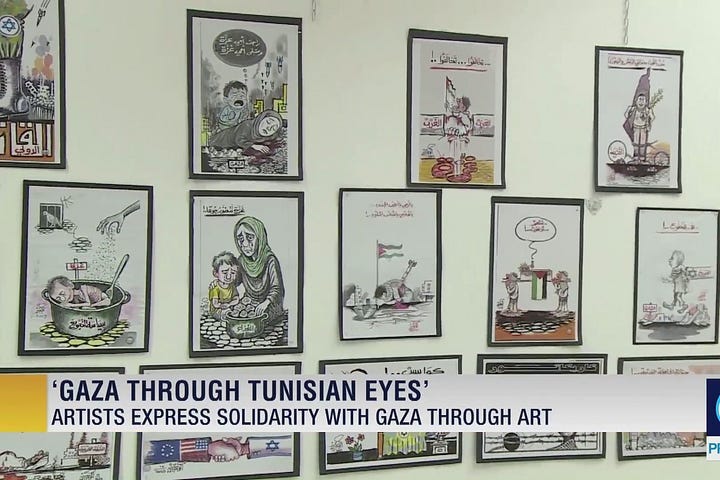
In the quiet corners of Ben Arous, just a heartbeat away from the Tunisian capital, a different kind of front line has been drawn. It is not marked by trenches or barbed wire, but by brushstrokes, vibrant colors, and the unyielding spirit of solidarity. Here, as the world watches the devastation in Gaza, the people of Tunisia have turned to the most enduring human language—art—to declare that while bodies may be broken, the narrative of resistance can never be erased.
This week, the air in Ben Arous was thick with memory. Marking Palestinian Martyrs’ Day, the Lady of the Earth Foundation curated an international art exhibition that did more than just display images; it resurrected the soul of a besieged people. The exhibition, dedicated entirely to Gaza, serves as a poignant reminder that the martyr is not merely a casualty of war, but a seed of future liberation.
To walk through the gallery is to witness “Gaza through Tunisian eyes.” It is a vision that refuses to see Palestinians solely as victims. Instead, the artworks capture the dual reality of life under occupation: the profound grief of loss and the ferocious beauty of steadfastness (sumud). Every canvas tells a story of a life that matters, a name that must be spoken, and a land that waits for its children to return.
The exhibition transcends the traditional role of a cultural event. In the context of the ongoing struggle, art elevates itself to a form of active resistance. When a history is being systematically targeted for erasure, painting it becomes an act of defiance. The artists in Ben Arous have wielded their brushes like torches, illuminating the dark reality of genocide while simultaneously lighting the path toward hope.
Tunisia’s connection to Palestine has always been visceral, a shared heartbeat of revolutionary struggle. This exhibition is the latest testament to that bond. It is a message sent across the Mediterranean: that Gaza does not bleed alone. The Lady of the Earth Foundation has created a space where the martyr is honored not with silence, but with the loud, vibrant expression of life that insists on continuing.
For the visitors and the artists, this was not just about looking at pictures. It was an act of witnessing. In a world that often turns its eyes away from the suffering of the oppressed, looking—truly looking—is a radical act. By immortalizing the struggle in art, Ben Arous has ensured that the legacy of the martyrs is etched not only into the history books but into the cultural consciousness of the region.
As long as there are walls in Gaza, there will be windows opened by artists in Tunisia. The canvas remains a battlefield, and in Ben Arous, the resistance is winning.