

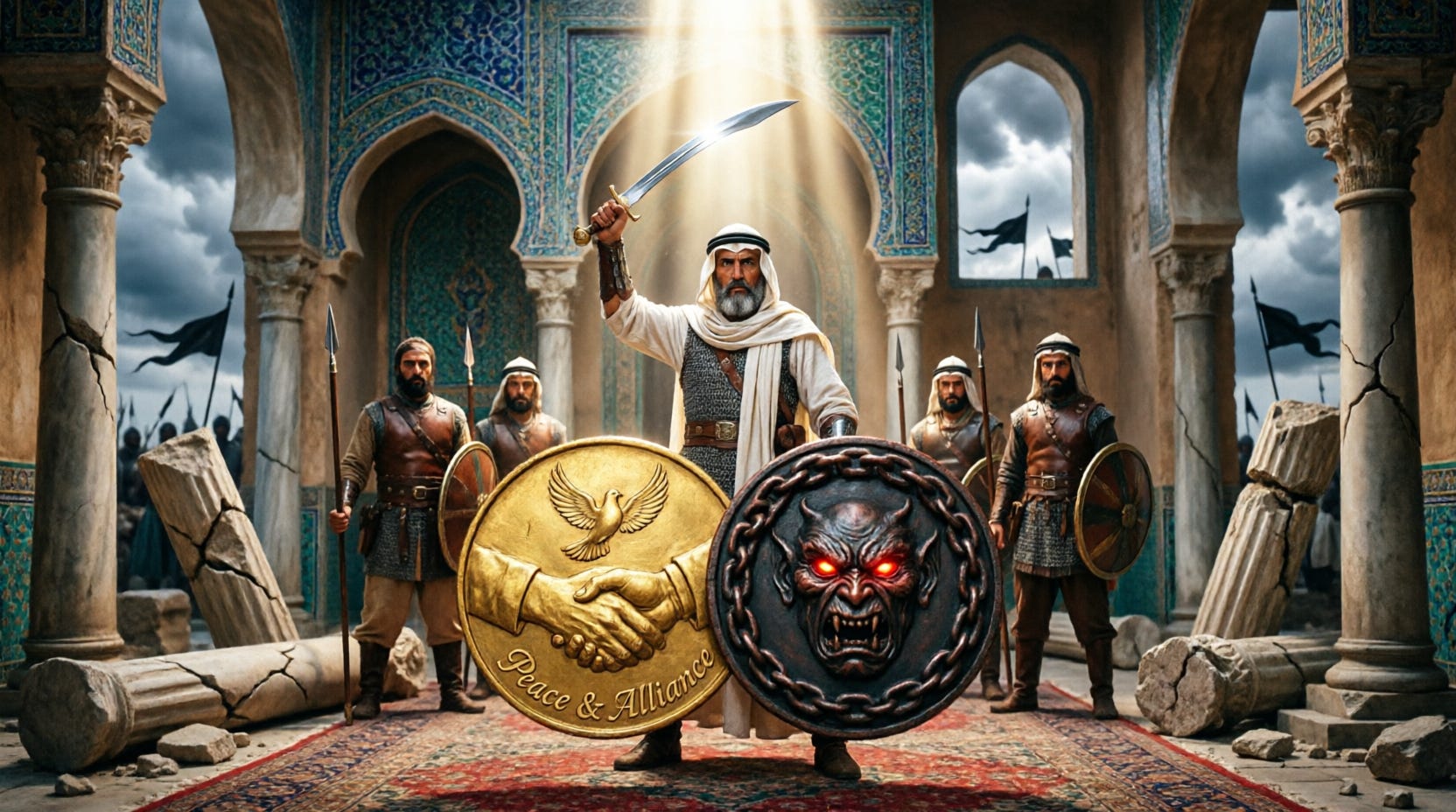
On the 14th of Ramadan, 67 AH (April 687 CE), the grand palace of Kufa was surrounded by a sea of hostile banners. Inside, a small band of loyalists stood shoulder to shoulder with a man who had shaken the foundations of the Islamic world. He was bleeding, outnumbered, and aware that the end was near. Yet, his voice did not tremble.
This was Mukhtar ibn Abi Ubayd al-Thaqafi. And the words he spoke in those final hours were not the desperate pleas of a defeated man, but the crystallised testament of a martyr who had fulfilled his divine promise.
To understand the weight of Mukhtar’s final speech, we must first understand the man, his life, and the monumental mission he carried on his shoulders.
The Man Forged in the Shadow of the Ahl al-Bayt
Mukhtar was born in Ta’if around 622 CE, the son of Abu Ubayd al-Thaqafi, a renowned commander who was himself martyred fighting for justice at the Battle of the Bridge. From a young age, Mukhtar was raised in the luminous shadow of the Prophet’s family (Ahl al-Bayt). He was a devoted companion of Imam Ali ibn Abi Talib (AS), absorbing the Imam’s teachings on justice, governance, and unwavering resistance to tyranny.
His commitment was tested early. When Imam Husayn (AS) sent his cousin, Muslim ibn Aqil, to Kufa to gauge support, Mukhtar was among the first to pledge his allegiance. When the tyrannical governor Ubayd Allah ibn Ziyad cracked down on the Imam’s supporters, Mukhtar was arrested, tortured, and imprisoned. Even from behind bars, he attempted to send a warning to Imam Husayn (AS) about the shifting loyalties in Kufa, a warning that tragically arrived too late.
The Great Uprising: “Ya Latharat al-Husayn”
After the tragedy of Karbala in 61 AH, a suffocating silence fell over much of the Muslim world. Rulers consolidated power, and many who had invited Imam Husayn to Kufa washed their hands of his blood.
But not Mukhtar.
In 685 CE, after years of strategic preparation, Mukhtar launched a historic uprising in Kufa under a singular, thunderous slogan: “Ya Latharat al-Husayn” (O, Avengers of Husayn). His mission was not to build a dynastic empire or amass personal wealth. His mission was a divine tribunal. He sought to bring the perpetrators of the Karbala massacre to justice.
Against all odds, Mukhtar seized control of Kufa. In a campaign that sent shockwaves through the Umayyad and Zubayrid camps, he systematically hunted down the architects of Karbala. Umar ibn Sa’ad, Shimr ibn Dhil-Jawshan, Khuli ibn Yazid, and others who had raised their swords against the Prophet’s grandson were tracked down, tried, and executed. Mukhtar sent their heads to Medina, fulfilling a grim but necessary promise to the grieving family of the Prophet (S). For a brief, shining period, the banner of justice flew over Kufa.
The Final Stand: The Siege of the Palace
Mukhtar’s success made him the primary target of the regional powers. Mus’ab ibn al-Zubayr, the ruler of Basra and brother of the caliph claimant Abdullah ibn al-Zubayr, marched on Kufa with a massive, well-equipped army.
Betrayed by some of his own commanders who defected to the enemy, Mukhtar was forced to retreat into the Qasr al-Imara (the Governor’s Palace) with a few thousand loyal companions. For days, they withstood relentless assaults. When it became clear that the palace would fall, Mus’ab offered Mukhtar safe passage if he would surrender alone.
Mukhtar refused. He declared that he would not abandon the men who had stood by him in the name of the Ahl al-Bayt. He chose martyrdom over a life of compromised exile.
The Last Speech: A Warning Against Hypocrisy
As the walls were breached and the final battle commenced, Mukhtar gathered his steadfast companions. Historical accounts, echoed and immortalised in the cultural memory of the Ummah, record that his final address was a masterclass in clarity, courage, and spiritual insight.
He looked at his men and summarised his life’s work with profound simplicity:
“I am a man from the Arabs. I saw that Ibn al-Zubayr had seized control of the Hejaz, Najdah had seized control of Yamamah, and Marwan had seized control of Syria. I did not see myself as inferior to other Arabs, so I took hold of this land... except that I sought revenge for the blood of the family of my Prophet, while others neglected this matter. I have killed everyone who participated in shedding their blood, and I will continue to kill them until I die.”
He then turned their attention to the nature of the enemy they were about to face. He warned them that the greatest danger was not the swords of the army outside, but the insidious hypocrisy (Tazwir) of the ruling class. He described this hypocrisy as a two-faced coin: one side dressed in the garments of piety, religion, and political legitimacy to fool the common people; the other side bearing the image of Iblis (Satan), visible only to the people of knowledge and insight.
His final, chilling warning to his companions was a call to unbreakable resolve:
“Do not let them break your resistance, for once they overcome you, they will snap your necks.”
With those words, he drew his sword. Mukhtar fought fiercely until he was struck down, achieving the highest rank of martyrdom (Shahadah). He died as he lived: unyielding, principled, and entirely devoted to the family of the Prophet.
An Enduring Tribute
Today, centuries later, the empires that sought to crush Mukhtar al-Thaqafi have turned to dust. The names of those who betrayed Imam Husayn (AS) are cursed in the annals of history. But the name of Mukhtar is etched in light.
He teaches us that it is never too late to stand for justice. He teaches us that one man’s unwavering commitment to the truth can dismantle the machinery of oppression. And most importantly, his final speech remains a timeless warning: never be deceived by the hypocritical alliances of the powerful, for those who compromise with falsehood will ultimately be destroyed by it.
We honour Mukhtar ibn Abi Ubayd al-Thaqafi not merely as a historical figure, but as a timeless symbol of resistance. His blood watered the seeds of justice, and his final words continue to echo through the corridors of time, urging every generation to choose the difficult path of truth over the comfortable path of complicity.
Peace be upon the Avenger of Husayn, and upon all those who walk in his footsteps.
If only Mukhtar was here to see that still, only a handful of the shia have joined Hussain and thus, after 500 years, Imam Mahdi remains in occultation. Peace be upon the avenger of Hussain ibn Ali