

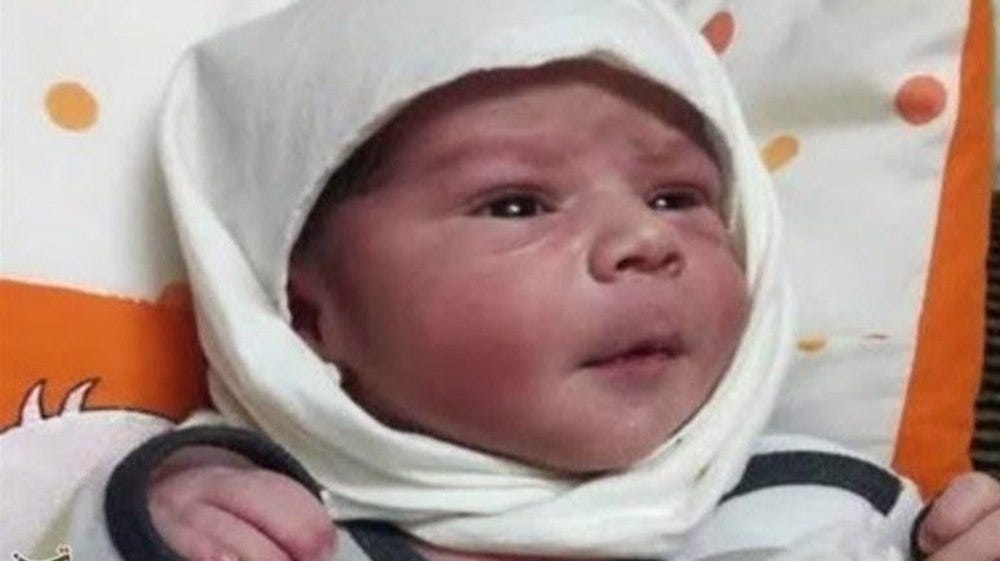
“Mojtaba was a moon.” That is how artist Parisa Rashidi describes Sayyed Mojtaba Sajedifar, the three-day-old infant whose life was brutally cut short before it could even begin to bloom.
In the early hours of March 15, 2026, at around 4:36 a.m., a US-Israeli airstrike targeted an ordinary family home in Amrabad, a village in the Masumieh district near Arak, central Iran. In this unprovoked act of aggression during the 40-day war against Iran, four members of the Sajedifar family were martyred while they slept.
Sayyed Mojtaba was martyred in the arms of his mother, Somayeh Mohammadi. The strike also claimed the lives of his two-year-old sister, Fatemeh Noura, and their grandmother, leaving one other family member injured. There were no military positions or installations near the site; the missiles deliberately struck a rural home where an ordinary family lived in peace.
Echoes of Karbala
For the family, Mojtaba’s arrival was a moment of profound joy. Long before his birth, they had prepared for him, imagining the beautiful life that lay ahead. During his mother’s pregnancy, the family had planned to bring their newborn to the Worldwide Hosseini Infants Gathering, held annually on the first Friday of Muharram to commemorate Hazrat Ali Asghar (AS), the infant son of Imam Husayn (AS) who was martyred at the Battle of Karbala.
Tragically, when the gathering took place four months after the airstrike, the family that had hoped to introduce Mojtaba to the world was instead mourning four martyrs. For the people of Arak, the martyrdom of a newborn in his mother’s arms evoked deep historical and spiritual wounds, drawing painful parallels to the timeless tragedy of Karbala and the suffering of innocent children throughout history.
A Deep Wound for the Community
The massacre of an entire family in a single moment has left a deep scar on the local community. “The martyrdom of a three-day-old infant may be just a news story to many people around the world, but for us, it is a deep wound,” one young student from Arak shared.
Parents across the region were heartbroken. One mother expressed her anguish, asking what threat an ordinary family could possibly pose to the US and Israeli regimes. “Imagine an entire family being wiped out in a single moment. They were simply an ordinary family living in their home,” she said. The deliberate targeting of residential neighbourhoods and children has only reinforced the belief among Iranians that the military campaign is a cowardly attempt to intimidate and harm civilians.
“Heroic Innocence” Immortalised in Art
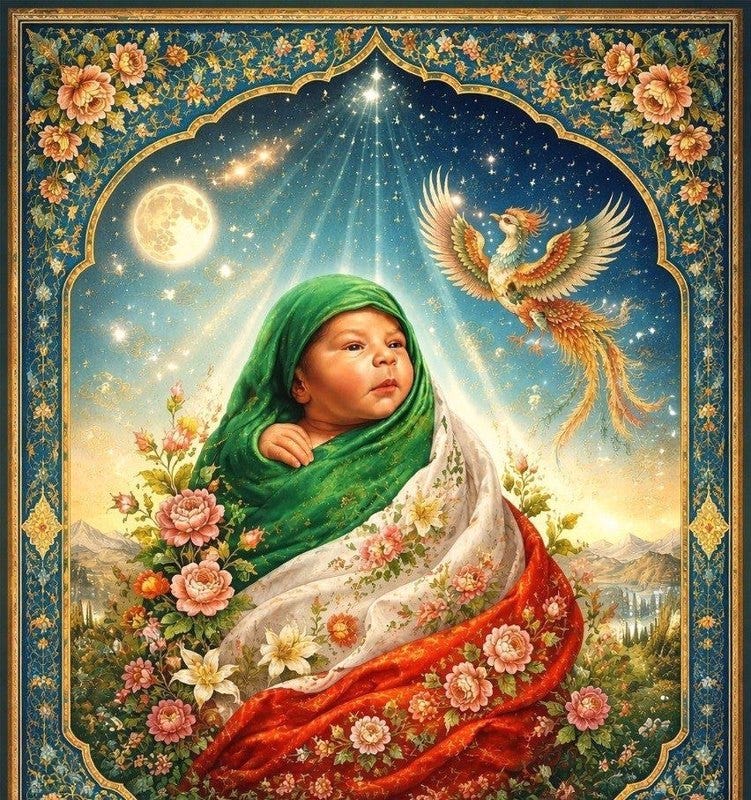
During the sacred month of Muharram, artist Parisa Rashidi unveiled a portrait painted in the newborn’s memory, later presenting it to his grieving father. Titled Heavenly Infant, Three-Day-Old Martyr, the artwork depicts the baby surrounded by stars, flowers, and a crescent moon, with a Simurgh rising behind him and the Iranian tricolour wrapped gently around his body.
Rashidi explained that the imagery merges themes of Ramadan, innocence, Iranian identity, and the mourning traditions of Shia Islam. The Simurgh represents the ascent of the infant’s pure soul, while the stars signify the enduring light of truth.
“My aim was not simply to depict a face, but to narrate a form of ‘heroic innocence,’” Rashidi stated. “This work was my tribute to the great spirit of this little man. He was never given the opportunity to live, yet through his innocence, he left in history an eternal narrative of sacrifice.”
Today, Sayyed Mojtaba Sajedifar stands as the youngest martyr of this brutal war. His name has transcended the fleeting nature of news cycles, becoming a lasting symbol of innocent blood spilled by aggressors and a testament to the unwavering spirit of a nation that refuses to be broken.
Reference: PressTv