

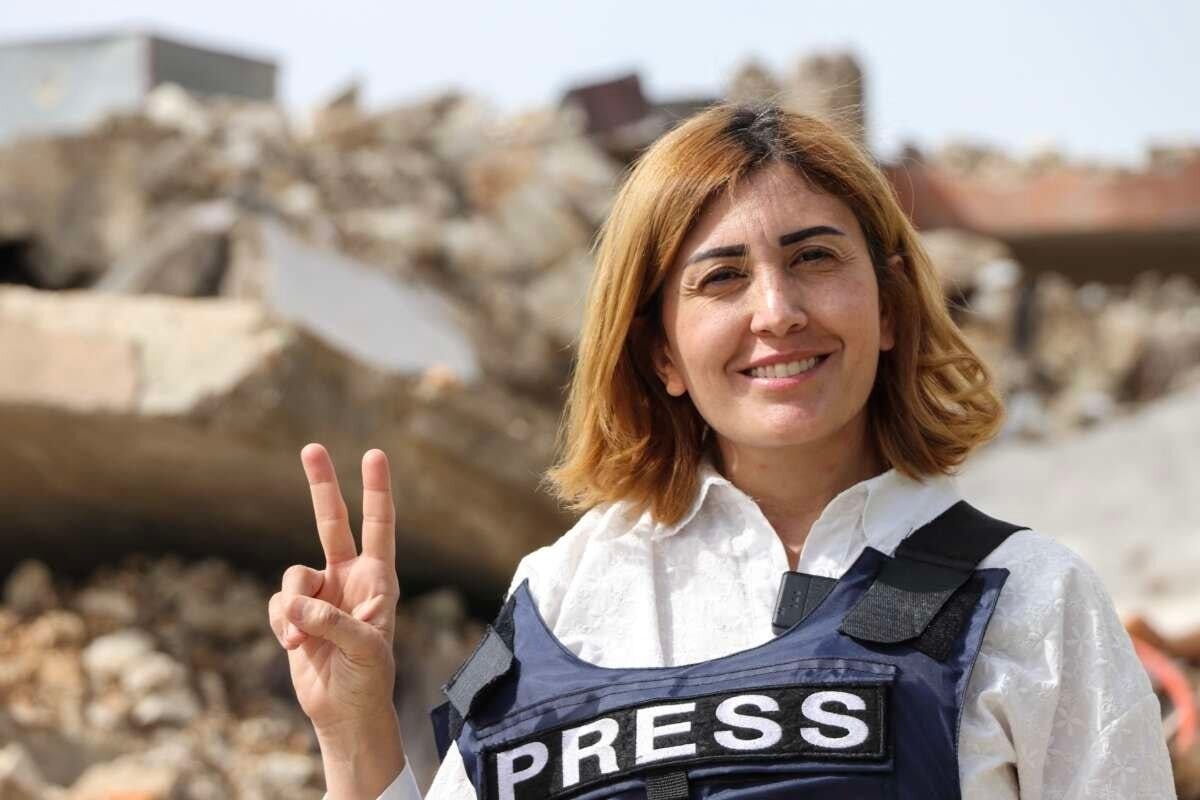
Some journalists chase stories. Amal Khalil belonged to one. She was born in southern Lebanon, lived in southern Lebanon, and on the afternoon of 22 April 2026, in a small house in al-Tayri, where she had taken shelter from one Israeli strike only for a second to find her, she died there too. The land she had reported on for nearly twenty years closed over her, and she became the story she had spent a lifetime refusing to be.
She was forty-three. She had been a witness since she was twenty-two — since the July war of 2006, when she first walked the rubble of her own region with a notebook, and would not stop walking it for the rest of her life. Born in 1984 in al-Baisariyah, a village in the Saida district, she came into the world while Israeli soldiers still occupied her country’s south. She left it while they were bombing it again.
To read her dispatches for Al-Akhbar was to feel that she knew every face she wrote about. She did not parachute into stories. She went home to them. Her colleagues, even the ones who competed with her, remember her as the journalist who would hand you her contacts, her sources, her hard-won keys to the south, and ask only that you tell the truth about what you saw. The young reporters she mentored say she was generous in a profession that rarely is.
She was, by every account, fearless — not in the loud way fearlessness is sometimes performed, but in the patient, daily way of a person who has decided there is somewhere she will not leave. In August 2024, an unknown Israeli number messaged her on WhatsApp. Leave the south, it said, or your head will not stay on your shoulders. Other messages followed, citing details of her life to make sure she understood she was being watched. She did not leave. She kept reporting. She said, more than once, that her presence among the people of the south since 2006 had always been the right choice, and she was not about to make a different one now.
She did not want to be in front of the camera. She taught herself video editing so she could keep her face out of her own films. She was there, she said, to tell the stories of the people — not to become one of them. The cruelty of her death is that the occupation forced her into the frame anyway.
What happened in al-Tayri on the afternoon of 22 April was not a tragedy of war. It was a sequence. An Israeli drone struck a car that she and the photographer Zeinab Faraj had been following, killing the people inside. The two women ran to a nearby house. From inside it, Amal phoned her editors. She phoned her family. She phoned the Lebanese army. The president of Lebanon, while she was still alive beneath the sky, publicly asked the Red Cross and the United Nations to save her. At 4:27 pm, a second strike collapsed the house. Faraj was eventually pulled out, alive. The Red Cross, attempting to reach Amal, was driven back by stun grenades and gunfire. They were prevented from returning for hours. By the time they recovered her, she was dead.
She was the ninth journalist killed in Lebanon this year.
Her brother Ali said, quietly, that Amal had been present in every home in Lebanon, and that every home in Lebanon had now lost her. He said she resembled the south in all its details — its breeze, its valleys, its old houses. Friends remembered the things that did not fit on a press card: that she planted fruit trees with her father in the courtyard of the family home, that she fed the stray cats of the village, that her smile was at home among the thyme and the tobacco fields.
A line from one of the tributes to her has already passed into the language of those who loved her: that Amal wrote her final report in her own blood. It is the kind of phrase that could feel like an excess of grief in another context. Here, it is only accurate. Her body was her last dispatch from the south. Her death told the story she had been telling all along — that to be a journalist on this land, to refuse to be moved off it, is to bear witness with your whole life, until your life itself is the witness.
She wanted no monument larger than the South itself. The south will have to do.
She is survived by her family, her colleagues, and the words she leaves behind — words that, as one of her mourners wrote, continue their mission after her absence: a quiet human act in the face of forgetting.