

Islam’s first sanctuary was granted by the Abyssinian Christian king, An-Najashi. When the early companions of the Prophet Muhammad (peace be upon him) were being persecuted and tortured in Makkah, the Prophet instructed two groups of Muslims to migrate to Abyssinia, where they would find protection under the just rule of An-Najashi. The Prophet (peace be upon him) also wrote to the king, informing him of his prophethood and requesting that his cousin Jaʿfar ibn Abi Talib be treated with respect. An-Najashi later responded with a letter declaring his belief in Islam and sent gifts to the Prophet along with his reply. In Surah Al Imran, ayat 113 this mutual respect for Christians is mentioned, stating
‘Yet they are not all alike: there are some among the People of the Book who are upright, who recite Allah’s revelations throughout the night, prostrating ˹in prayer˺.
Abyssinia, known today as Ethiopia, was historically connected to the Oriental Orthodox tradition and remains linked to the Orthodox Church of Alexandria. The Coptic Orthodox Church, established in Egypt between 42–60 AD by Saint Mark the Apostle, is one of the world’s oldest Christian communities. As an apostolic and orthodox church with a rich monastic heritage, it traces its roots directly to the evangelist who wrote the second Gospel and served as the first Bishop of Alexandria.
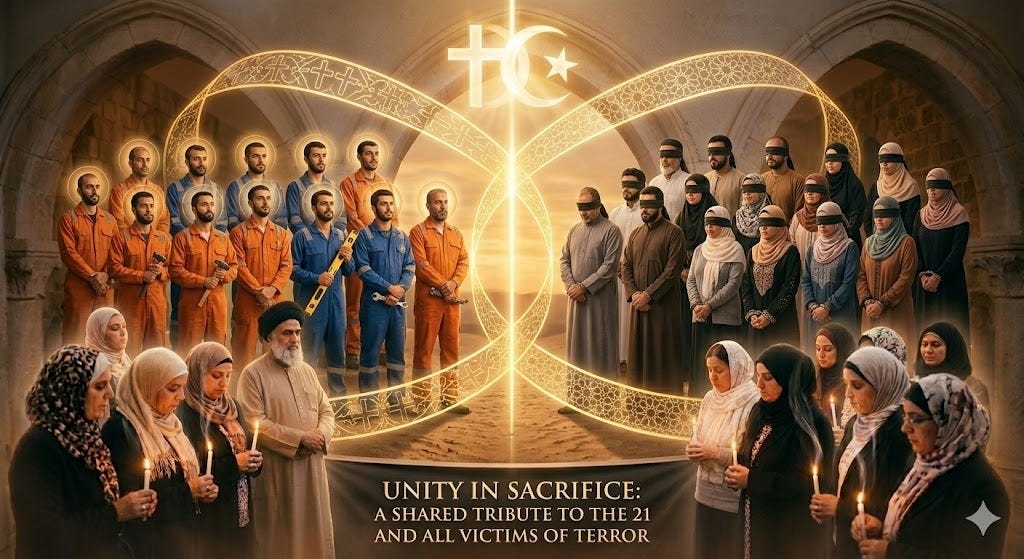
Tragically, it was members of this very church who were brutally martyred for their faith on 15 February 2015 by the extremist group calling itself the Islamic State (ISIS). Twenty Coptic Christians who were primarily humble labourers and construction workers and one Ghanaian man were marched along a Libyan beach by their captors and given one final opportunity to renounce their faith before being beheaded. The haunting image of those believers kneeling in prayer as they awaited execution remains etched in the hearts and minds of many of the families and communities of the church.
This brutality by ISIS has not only been committed against Christians, but also against Shia Muslims and other religious minorities in Iraq, Syria, and beyond. The group poses a threat not only to people of other faiths but also to the very fabric and nature of Islam itself. Its violent ideology, cloaked in religious language, distorts Islamic teachings and seeks to establish a caliphate rooted in brutality and power rather than in the mercy, justice, and spiritual integrity exemplified by the Prophet (peace be upon him).
In response to the killings of the 21 Coptic Christians in Libya, Iranian Foreign Ministry spokeswoman Marzieh Afkham strongly condemned the crimes, stating that such acts aim to inflame religious, ethnic, and tribal divisions, undermining relations between followers of major religions and damaging unity among nations.
In a world where truth and faith in the One God are increasingly challenged, believers must resist division and stand united. Forces of hatred thrive on conflict, but history reminds us of a different model — one of protection, coexistence, and mutual respect. Just as the Christians of Abyssinia offered refuge to the early Muslims, people of sincere faith today can choose solidarity over suspicion, peace over violence, and compassion over hatred. The bible also warns against the corruption of forces that create disunity and violence in Ephesians 6:12:
‘For we do not wrestle against flesh and blood, but against the rulers, against the authorities, against the cosmic powers over this present darkness, against the spiritual forces of evil in the heavenly places.’
Let those of true faith rise above the troubles of this world, supporting one another in dignity and respect, and honouring each other’s paths toward the worship of the One God.