

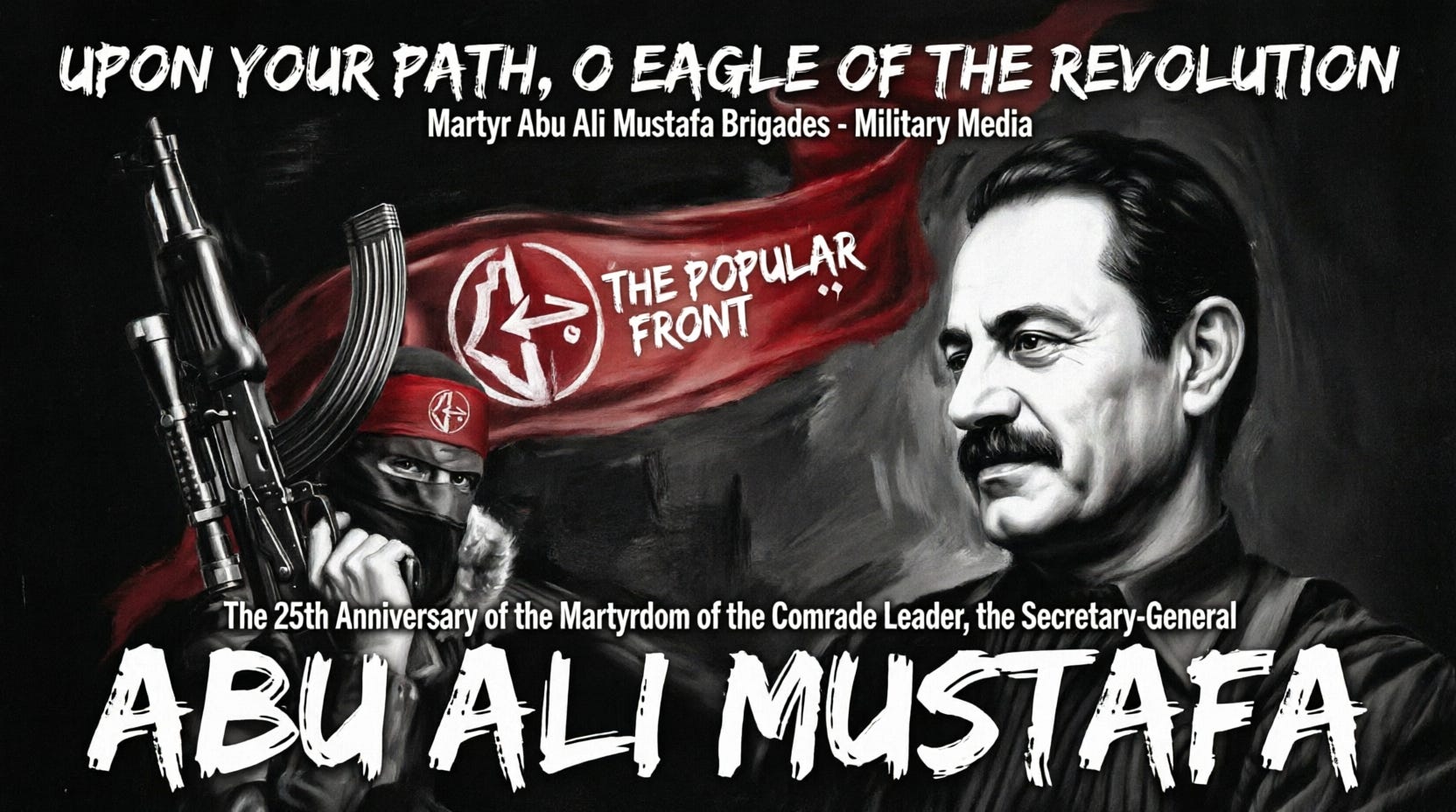
On the morning of 27 August 2001, missiles fired from Israeli Apache helicopters pierced the window of an office in Ramallah, killing Mustafa al-Zabri — known to his people and comrades as Abu Ali Mustafa, Secretary-General of the Popular Front for the Liberation of Palestine (PFLP).
He was 63 years old, and he died as he had lived: at his post, on his land, having refused every suggestion that he shield himself from danger by leaving it.
For those who mourn him, his martyrdom was not an ending but a covenant. In his own words, preserved in his final interviews:
“Palestine belongs to the Palestinian people; Palestine is ours. We do not surrender Palestine to anyone else.”
A Child of Arraba
Mustafa al-Zabri was born on 14 May 1938 in the town of Arraba, near Jenin, the son of a farming family of modest means.
He was ten years old when the Nakba swept over Palestine in 1948, and like so many children of his generation, loss, exile and defiance were written early into his memory. At seventeen, he joined the Arab Nationalist Movement, and from that day until his last breath he never left the ranks of the struggle.
After the occupation of the West Bank in 1967, Abu Ali Mustafa stood among the founders of the Popular Front for the Liberation of Palestine, helping build the organisation that would become one of the pillars of the Palestinian national movement.
In the long years of exile — Amman, Beirut, Damascus — he was the quiet backbone of the Front: a man known less for grand speeches than for discipline, austerity and unshakeable calm.
The Secretary-General of Steadfastness
After thirty years in exile, Abu Ali Mustafa returned to the occupied homeland in 1999, and in 2000 the Front elected him Secretary-General, succeeding Dr. George Habash.
He took the helm as the Second Intifada erupted, and led with the same quiet firmness that had marked his whole life — a leader who lived as simply as his people lived, and who regarded leadership as a burden of responsibility, not a privilege.
In his last interviews, he spoke not of himself but of his people:
“We are the resisting people, we are the resisting people.”
Martyrdom at His Desk
Israel, which held him responsible for the Front’s operations during the Intifada, decided to kill him.
On 27 August 2001, helicopter-fired missiles struck his office as he sat at his desk — the highest-ranking Palestinian leader assassinated at that point in the Intifada.
His funeral became a sea of mourners swearing that the barricades would not fall.
He had known for some time that his name was on the list. He refused to change his habits, abandon his office, or leave his land. In that choice lay the whole meaning of his life: the origin is to be in Palestine.
The Barricades Remain
After his martyrdom, the armed wing of the Front took his name — the Martyr Abu Ali Mustafa Brigades — and carries it to this day.
But more important than any name is the idea he left behind: that resistance does not die with the martyr, because it lives in the people.
“Even if the enemy managed to exterminate all of us, and there remained in Palestine a single child — the resistance is present,” he said. And he told his people, as if speaking to this very hour: “Let the enemy perish if it thought that our barricades have collapsed — our barricades remain.”
Twenty-five years on, the man from Arraba remains what he was in life: a symbol of steadfastness, a leader who never asked of his people what he did not give himself, and a martyr whose covenant, in the words of his brigades, will never fade.
We are the resisting people — and the barricades still stand.