

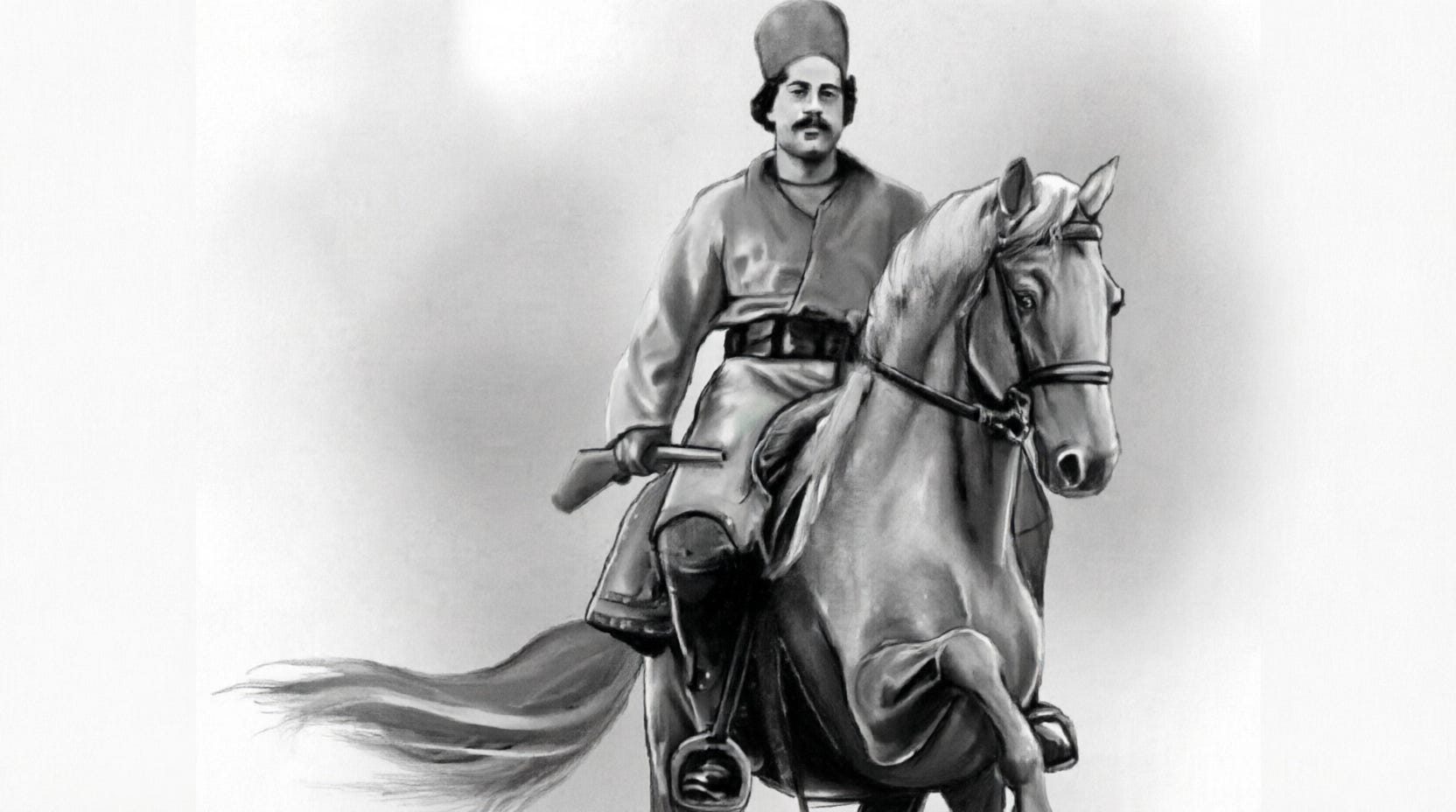
Each year on 3 September, Iranians — and especially the people of the southern coast — commemorate the martyrdom of Rais Ali Delvari, a man who with a handful of fighters and an unshakable conviction stood against the full weight of the British Empire at the height of the First World War.
A Son of Tangestan
Rais Ali was born in 1882 in Delvar, a small port town in the Tangestan region near Bushehr on the Persian Gulf. His father, Rais Mohammad Delvari, was a local chief who had himself confronted foreign encroachment on the coast, and from him the young Ali inherited both his title — rais, meaning chief or leader — and a tradition of defiance. The men of Tangestan were renowned as marksmen and seafarers, and Rais Ali grew into a leader whose authority rested not on wealth but on courage, faith and justice.
Empire Comes to the Gulf
By the early twentieth century, the Qajar state was too weak to shield Iran from foreign domination. Britain and Russia had carved the country into spheres of influence, and London treated the Persian Gulf as its own lake — a highway for trade, telegraph lines and, once oil was discovered, imperial lifelines. When the First World War erupted, Iran declared neutrality, but neutrality offered no protection. In 1915, British forces occupied Bushehr, determined to secure the Gulf, guard the oilfields and crush any local resistance. For the people of Tangestan, occupation was not an abstraction; it was foreign soldiers on their own soil.
The Uprising
Rais Ali, then in his early thirties, answered with armed resistance. Rallying the fighters of Tangestan, he waged a guerrilla war against the occupation: ambushes on patrols, night raids on encampments, and harassment of supply lines. His riflemen, lightly armed but deeply motivated, inflicted casualties and humiliation on a far more powerful force, and made the coast ungovernable for the occupiers.
British officers, accustomed to purchasing local notables, reportedly attempted bribery — money, weapons and office in exchange for submission. Rais Ali’s answer, preserved in local memory, was refusal: the homeland was not for sale. Wartime intrigue swirled around the region, with German and Ottoman agents also seeking to stir rebellion for their own ends, but the resistance in Tangestan drew its strength from its own soil — the conviction that a foreign flag had no place on Persian shores.
Martyrdom
The empire that could not defeat Rais Ali in the field eventually found another way. On 3 September 1915, he was killed by treachery — shot, according to the most common account, by a man within his own circle who had been bribed by the British. He was around 33 years old.
His killers hoped his death would end the uprising. It did not. Resistance in Tangestan flared on, and the name Delvari became a byword for defiance; the British, for all their gunboats and expeditions, never comfortably pacified the coast. In Iranian national memory, Rais Ali joined the pantheon of martyrs who proved that occupation, however powerful, always carries a price.
Legacy
Today, Rais Ali Delvari’s home in Delvar is preserved as a museum, holding the rifles, documents and relics of the southern resistance. His name is carried by streets and squares across Iran, and his story is told alongside those of other anti-colonial heroes of the era, such as Mirza Kuchak Khan of Gilan. Every 3 September, ceremonies on the Bushehr coast recall not only how he died but how he lived: as a chief who asked nothing for himself and gave everything.
More than a century on, the lesson of his martyrdom remains the one his countrymen repeat each anniversary: empires measure their power in gunboats and gold, but the memory of a people is longer than the reach of empires. The Lion of Tangestan still roars in that memory.