

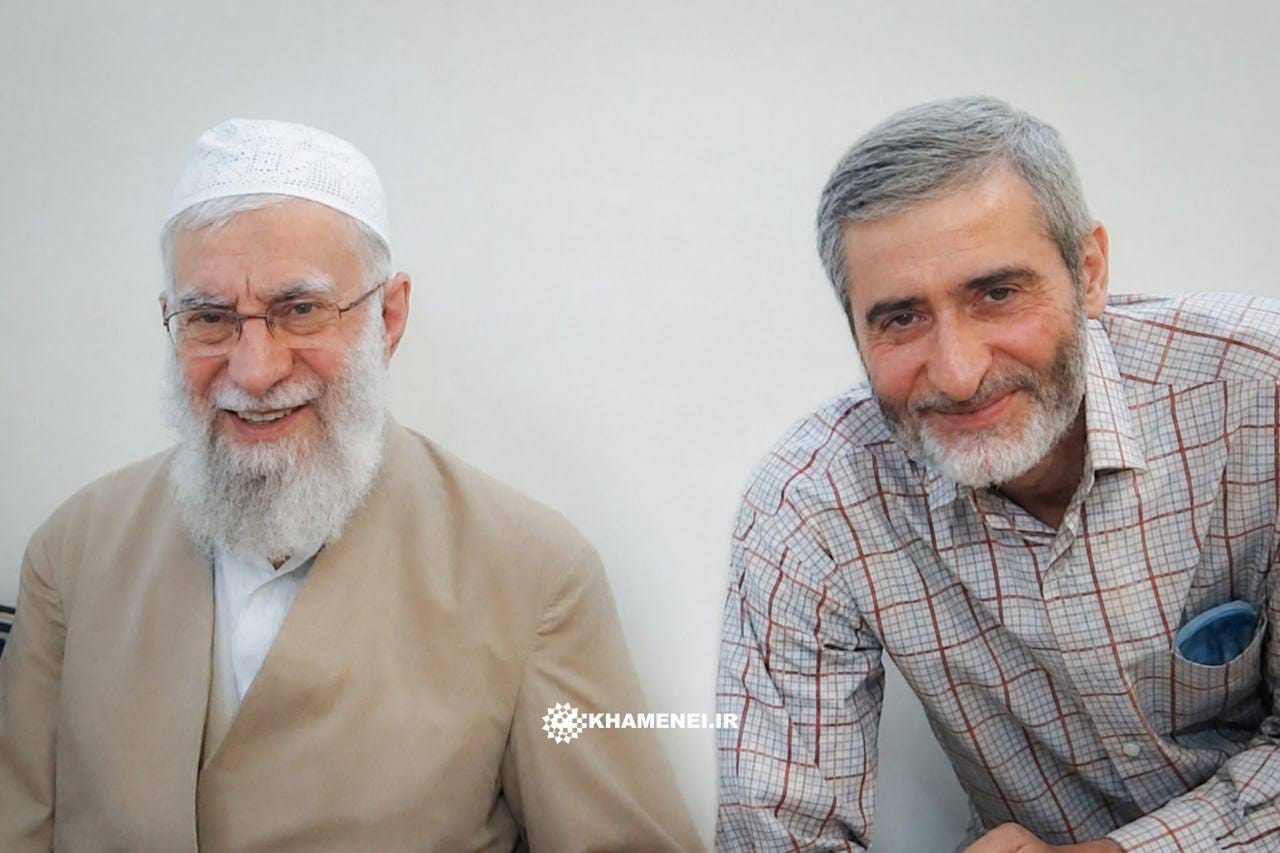
There are lives that are measured by what a person gathered — titles, wealth, nearness to power. And there are lives measured by what a person quietly refused. Dr. Mesbah al-Hoda Bagheri Kani lived the second kind. He stood, as an old friend would later write, at the very crossroads of opportunity, within arm’s reach of influence and comfort, and he turned away from it again and again, choosing instead a desk, a classroom, and the unglamorous work of serving others. On the morning of February 28, when the American and Israeli strikes fell, he refused one last door — the one that led away from danger — and stayed beside the Leader and the family. He was martyred in the opening moments of the attack.
This week, in the Motahhari auditorium of Imam Sadiq University, the people who knew him best gathered not to recite his résumé but to remember his manner. And it was his manner, more than his many accomplishments, that they could not stop speaking of.
A teacher who put people before the rules
Ask his students, and they will not begin with his publications. They begin with how he made them feel. He was a professor, but he wore the title lightly — less a manager than a companion who happened to know more than you did and never let you feel it. When the rules of an institution collided with the needs of a human being in front of him, it was the rules that bent. People matter, he believed, and he ran his corner of the university as though that were the only policy worth enforcing.
His colleagues saw the same thing from the other side of the lectern. To Dr. Pourezzat of the University of Tehran, he was that rarest of academics: one for whom scholarship was never a monument to be admired but a tool to be used, taken up to solve some real problem in the lives of real people. He listened — truly listened — and then he went to work on your behalf, often placing your interests somewhere ahead of his own without ever mentioning that he had done so.
Born close to power, indifferent to it
He came from one of Iran’s great scholarly families. His father was Ayatollah Mohammad Bagher Bagheri Kani; his uncle, the late Ayatollah Mahdavi Kani, once chaired the Assembly of Experts and founded the very university where he would spend more than two decades of his life. His brother sits on the Supreme National Security Council. And in time he married Sayyedeh Hoda Khamenei, the youngest daughter of the Leader of the Islamic Revolution himself.
Any one of these ties could have been spent like currency. He spent none of them. Those who loved him return, again and again, to this single astonishing fact: that a man so near to everything the world prizes wanted so little of it. When the marriage into the Leader’s family was arranged, Ayatollah Khamenei set down one condition — that his son-in-law keep clear of political and economic affairs. It reads today less like a restriction imposed on him than a description of what he already was. He kept that condition faithfully to the end, and seems to have kept it gladly.
Born in 1973, he gave his working life to teaching and to thinking about how the principles of his faith might shape the way institutions are run — Islamic management, public policy, the quiet architecture of good governance. He edited journals, mentored doctoral students, sat on boards, and lent his hand to cultural life, where writers and filmmakers still recall the small, unasked-for kindnesses he scattered behind him. But to reduce him to this list is to miss him entirely. The list was never the point. It was only the shape his devotion happened to take.
The making of a soul
His brothers speak of a man forever at work on himself. He did not obey his father out of mere duty; he studied him, turned each brief remark over like a stone in the hand, searching for the deeper meaning beneath it. “Every short sentence from our father,” they recalled, “became an occasion for reflection and self-correction.” He approached his father-in-law and Leader the same way — not with the stiff formality of respect, but with a hunger to understand a vision and then to live inside it.
The trait his brother Ali remembered above all was his reverence for the dignity of others. Rank meant nothing to him; a person’s standing in society counted for far less than their standing as a human being. He gave his own hours away freely to help ordinary people untangle their troubles, holding fast to a simple conviction — that in a just society, no one should ever be made to feel small. Those who watched him over the years describe something like a slow illumination after his marriage, a deepening of faith and humility that showed itself not in words but in the grain of his daily conduct.
His friend of thirty years, Dr. Amirpour, put it most plainly. Here was a man who could have had anything and asked for nothing, who continued his sincere work even as the threats around him grew, and who did not flinch from death when it came. “He never feared death,” Amirpour wrote. He served to his final breath, and in the end “chose flight over the prison of the body.”
The final morning
He was at home, a stone’s throw from the Leader’s residence, when the sky broke open. His brother, in a meeting a few blocks away, felt the blasts tear through the district — windows shattering, walls buckling. For a while the family let themselves believe he had been spared. He had not.
They do not call it an accident. They cannot. To them, everything about the way he had lived — the refusals, the self-examination, the widening light — had been leading him quietly toward this station all along. He would not leave the compound. Though the enemy’s threats had been open and public, he chose to remain with the Leader and the family, and so he was among the first to fall, alongside others of that household: Zahra Haddad Adel, and the Leader’s eldest daughter Sayyedeh Boshra, martyred with her fourteen-month-old, Zahra.
For his students, he will remain the teacher who put them before the rulebook. For his colleagues, the scholar who bent his learning toward mercy. For his family, the brother forever remaking his own soul. And for all of them, he will be the man who stood at the crossroads of the whole world — and chose the narrow road of learning, service, humility, and faith, walking it all the way to its end, in the footsteps of the Leader he loved.
May his soul rest in the nearness of the Imams he sought to follow.