

History remembers her as Ummul Banin—the “Mother of Sons”—but long before she bore that title, she was Fatima bint Hizam, a woman of warrior blood and noble lineage. She did not enter the house of Imam Ali by chance; she was chosen. When the Imam sought a wife after the loss of the beloved Lady Fatima Zahra, he asked for a woman born of a brave tribe, someone who would bear sons capable of defending Islam. He found that fire and nobility in her.
Yet, when she crossed the threshold of Imam Ali’s home, she did not enter as a replacement. She entered as a servant. It is said that upon her arrival, she told the young Imam Hasan and Imam Hussain, “I have not come here to take the place of your mother. I have come to be your maidservant.” She forbade anyone from calling her “Fatimah,” lest the name remind the grieving children of the mother they had lost. From that day on, she was Ummul Banin—a woman who defined herself by her devotion to the children of Paradise before her own.
The Gift of Abbas
It was from this deep well of humility that she raised her own four sons: Abdullah, Ja’far, Uthman, and the moon of the family, Abbas.
As the mother of Hazrat Abbas, she occupies a unique station. She did not raise Abbas to be a prince; she raised him to be a shield. From his childhood, she whispered into his ear that he was born for a single purpose: to serve his brother, Hussain. She taught him that while he was the son of Ali, Hussain was the son of the Prophet.
There is a touching narrative that when Abbas was an infant, Imam Ali kissed his small arms and wept, foreseeing the day they would be severed in defense of his brother. Ummul Banin did not shrink from this destiny; she embraced it. She nurtured in Abbas the loyalty that would eventually make him the standard-bearer of Karbala—the “Moon of the Hashimites” who would rather die of thirst than drink while his brother remained thirsty.
The Lament of Baqi
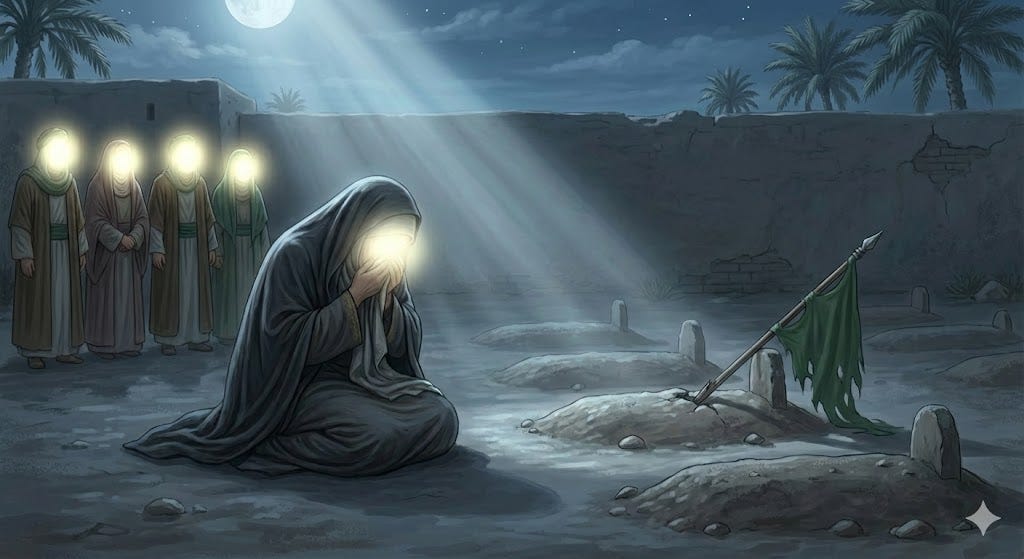
Her true test came after the tragedy. When the caravan returned to Medina, Ummul Banin did not just mourn; she became the voice of the revolution. She would go daily to the Jannat al-Baqi cemetery, drawing the people of Medina to her with her heart-rending eloquence.
It is recorded that she would sketch the outlines of four graves in the dirt, yet her tears would fall for a fifth—Hussain. There, under the open sky, she recited poetry that has echoed through the centuries, a lamentation not just of grief, but of pride in how her sons died.
She would cry out to the wind, reciting:
“O you who saw Abbas attacking the multitudes, And behind him, the sons of Haidar like lions! They told me my son’s head was shattered, While his hands were severed from his body. Woe is me! I know that if his sword were in his hand, No one would have dared approach him.”
And then, in a voice that broke the hearts of all who heard, she would ask the world to strip her of her title:
“Do not call me Ummul Banin (Mother of Sons) anymore, For that name recalls the lions I bore. I had sons, and by them, I was known and acclaimed, Now I am lonely, by grief reclaimed. Four sons I had, like falcons they flew, Cut down in the desert, their bodies strew.”
The Ultimate Sacrifice
Even in this immense grief, her loyalty to the Imam remained her defining trait. When the news bearer, Bashir, first arrived in Medina, he hesitated to tell her the truth. He announced the death of her sons one by one.
“News of Abdullah is here,” he said. She replied, “Tell me of Hussain.”
“News of Ja’far is here,” he said. She replied, “Tell me of Hussain.”
Finally, when he said, “News of Abbas is here,”—the son she had raised to be the perfection of loyalty—she still cried out, “Tell me about Hussain! My sons and everything under this blue sky are a sacrifice for Abu Abdullah.”
Only when she learned that Imam Hussain had been martyred did she truly break. Her grief was not for her own flesh and blood, but for the Imam of her time.
Her Legacy
She is the mother who gave everything. She gave four lions to the desert of Karbala, and she gave history the legend of Hazrat Abbas. To this day, when the faithful seek intercession, they turn to her—not just because she is the wife of Imam Ali, but because she is the mother who taught the world what it means to love the Divine Guide more than one’s own soul.