

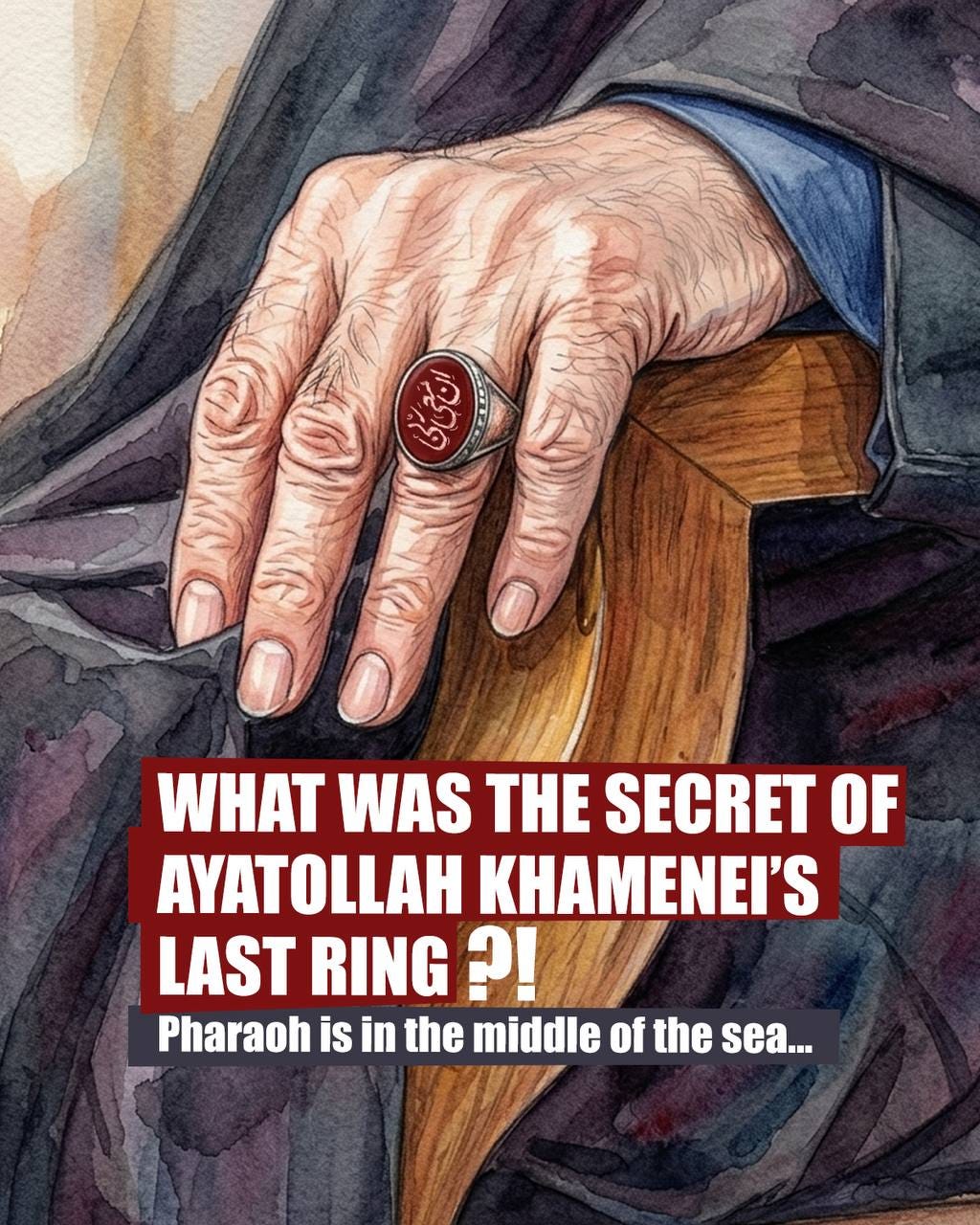
There is a photograph that will not leave you once you have seen it. An old man’s hand, weathered and veined, resting on the arm of a chair. On his finger, a ring. Inside the ring, a red stone. And on the stone, carved in a curling Arabic script: إنَّ مَعِيَ رَبِّي — “My Lord is with me.”
He wore it in the final days. He wore it while American warships circled the Gulf. He wore it while B-2 bombers cut the sky above his country. He wore it when the world held its breath and waited for Iran to break.
It did not break.
And now the old man is gone, and the ring is still speaking.
The story never ended
To understand the ring, you have to understand how Ayatollah Khamenei read the Quran. Not as an archive. Not as a bedtime tale. As a mirror held up to the present moment, glinting with warnings and promises that never expire.
Every age has its Pharaoh. Every generation has its Moses. The names change; the pattern does not. A tyrant rises. He thinks himself a god. He builds his palaces, his armies, his terrifying fleet. And he sets out to destroy a people who have nothing but faith.
This is the script. It has been running for three thousand years. And Ayatollah Khamenei, for decades, had been quietly telling his people: we are inside it right now.
The verse on his finger
Picture the scene the ring points back to. Moses has led his people to the edge of the Nile. Behind them, the dust rises — Pharaoh’s chariots, Pharaoh’s spears, the full weight of the empire bearing down. His companions break. “We’re being overtaken!” they cry. “It’s over!”
And Moses, who has no army, no weapons, no strategy but God, turns to them and says the impossible: “Never. My Lord is with me. He will guide me.”
Then the sea parts.
This is the verse Ayatollah Khamenei chose to wear on his hand as the empire of our time levelled its guns at him. Not a prayer. Not a plea. A declaration. A signature. A message engraved in stone for anyone who still had eyes to read.
Pharaoh at the door
Trump came with his fleet and his threats and his certainty. He sent Japan’s prime minister to Tehran with a message, expecting the old man to bend. The old man did not bend. “I do not consider Trump worthy of an answer,” he said — and the messenger went home empty-handed, and the world understood that something ancient had just happened again.
Then came the warnings. Ayatollah Khamenei, speaking with the calm of a man reading from a book only he could see: the tyrants always fall at the height of their arrogance. Pharaoh fell. Nimrod fell. This one will fall too. The Titanic, he said, was unsinkable until it sank. Empires are unsinkable until the water is at their throats.
Into the middle of the sea
And then the trap closed.
Because here is the terrible beauty of the Moses story that everyone forgets: the sea did not open to save the believers alone. It opened so that Pharaoh would step into it. It opened to swallow him.
When America stepped into direct war with Iran, it walked onto a road that looked, from above, like victory. From below, it was the seabed. The waves were already God’s soldiers. The calculations that looked so clever in Washington were the calculations of a drowning man who has not yet realised he is drowning.
He finished his work
The old man completed his mission. He led the enemy to the place where there is no way back. And then he left, quietly, the way prophets leave — with a ring still glowing on his finger, bearing the only words that ever mattered.
My Lord is with me.
Now the ring belongs to everyone who saw it. To every Iranian standing in the field. To everyone, anywhere, who has looked at the empires of this world and suspected — quietly, stubbornly, against all the noise — that the sea has already begun to close.
Look at the ring.
And be sure.