

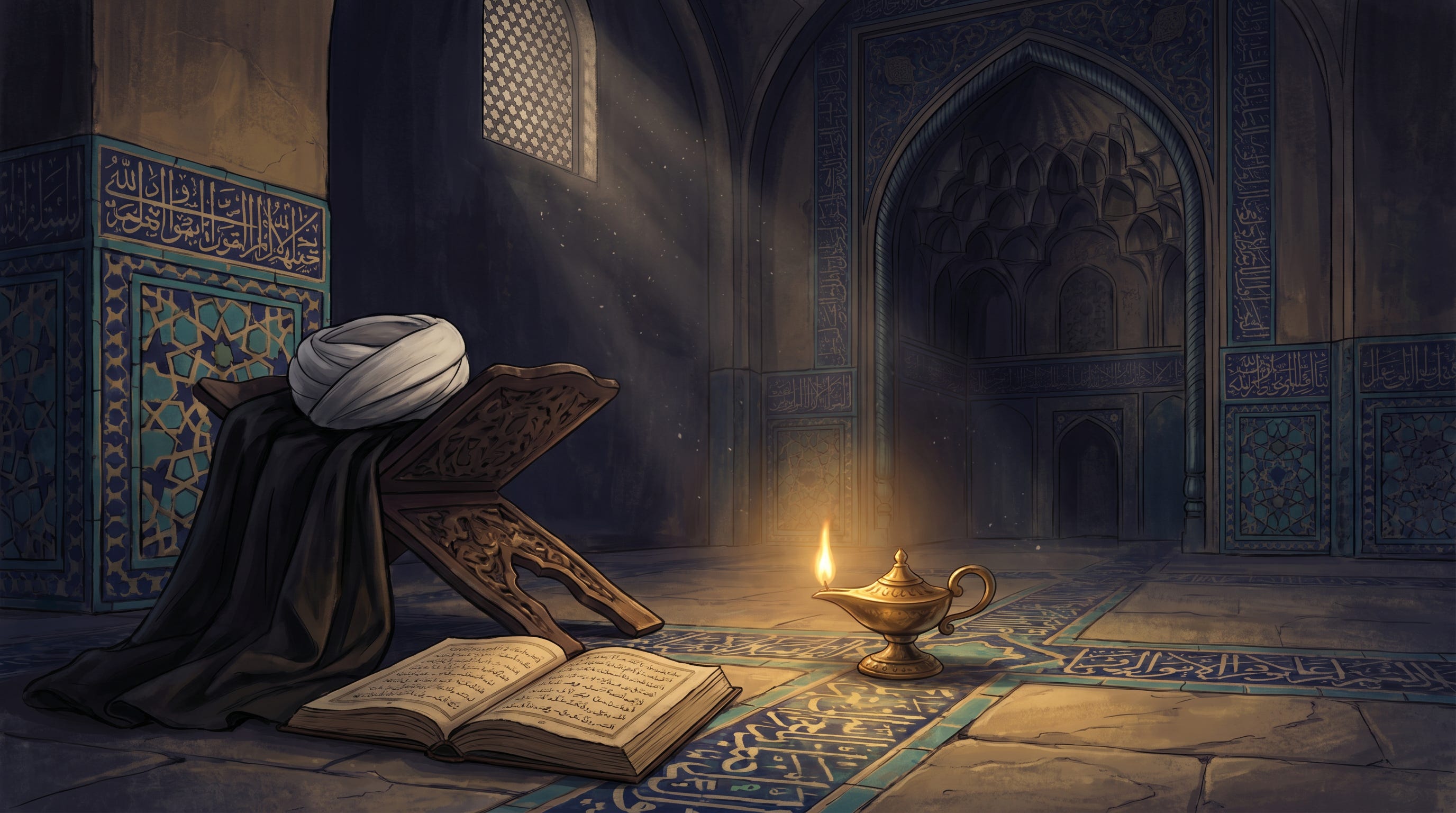
A Son of Shiraz, Named for Husayn
On the tenth day of Muharram in the year 1332 AH — 9 December 1913 by the common reckoning — a boy was born in the ancient city of Shiraz. His father, Sayyid Muhammad Taqi, was far from home that day, making pilgrimage in the sacred soil of Karbala. When news of his son’s birth reached him, standing at the shrine of Imam Husayn (peace be upon him) on the very anniversary of Ashura, he gave the child a name that would shape a lifetime: Abdul Husayn — the servant of Husayn.
The name was a promise. And for sixty-eight years, the child who bore it kept that promise in full.
He was born into a family of exceptional lineage. A Sayyid — a descendant of the Prophet Muhammad (peace be upon him and his family) — he came from a line of scholars and mujtahids whose intellectual heritage in Fars province stretched back some eight hundred years. His grandfather, Sayyid Hidayat Allah, and his father both stood among the recognised religious authorities of their region. Piety was not something Abdul Husayn had to seek; it was the air he breathed.
He lost his father at the age of twelve. But the orphan of Shiraz was not alone — the scholars of his city closed ranks around him, and he pressed forward with a seriousness that astonished his teachers.
The Young Imam and the Defiance of a Boy
By the age of twenty, he was already leading congregational prayers at the Baqirkhan Mosque in the Bazaar-Morgh quarter of Shiraz. A young man standing in the mihrab, guiding elders in the worship of Allah — this alone would have been a distinction for any cleric.
But those were the years of Reza Shah Pahlavi, and the regime had begun its war against the visible markers of Islamic faith. The turban and the cloak of the cleric were targeted. To keep his religious dress, the young Sayyid had to sit for humiliating state examinations designed to cull the ranks of the ulama. He passed them — but the regime soon found other reasons to silence him. His outspoken sermons brought arrest and imprisonment. Finally, he was given a cruel choice: abandon the robe of the scholar, or leave the country.
In 1935, he chose exile over compromise and set out for Najaf al-Ashraf — the city that shelters the tomb of the Commander of the Faithful, Imam Ali (peace be upon him).
Najaf: Where the Scholar Was Forged
In the hawza of Najaf, he sat at the feet of giants. Ayatollah Sayyid Abu al-Hasan Isfahani, Ayatollah Muhammad Kazim Shirazi, and others of that extraordinary generation poured their learning into him. He immersed himself in jurisprudence, the principles of jurisprudence (usul al-fiqh), theology, Quranic exegesis, and the Arabic language — and in time he was granted the ijaza of ijtihad, the formal permission to derive religious law independently from its sources.
But what his teachers saw in him was something beyond legal competence. He had a trembling heart. He wept in prayer. He spoke of the Hereafter not as a theologian citing references, but as a man who seemed already to be walking its edge. His teacher, Muhammad Kazim Shirazi, recognising that this student’s place was among the people, urged him to return home. And so, after the fall of Reza Shah, Shiraz received back her son — no longer the young man who had left, but a mujtahid and a guide.
The Reformer of Shiraz
Back in his native city, Ayatollah Dastghaib threw himself into the work of spiritual renewal. He spent lavishly from his own pocket to restore the Jame Masjid Ateq, the great congregational mosque of Shiraz, which had fallen into disrepair. He taught. He counselled. He opened his home to the poor. He gathered around him generations of students who would carry his influence across Iran.
And he wrote.
His books were not written for the scholarly elite alone. They were written for the believer who wanted to pray better, to fear Allah more sincerely, to understand the weight of his deeds. Among his enduring works are:
Gunahan-e Kabira (The Greater Sins) — perhaps his most widely read work, a three-volume exposition of the major sins in Islam, still printed and translated across the Muslim world
Qalb al-Salim (The Sound Heart) — a treatise on the purified heart as the only currency accepted on the Day of Judgement
Salat al-Khashi’een — on the prayer of those who tremble before Allah
Ma’ad — on the Return to Allah and the realities of the Hereafter
At-Tawba — on the science of repentance
Biographies of Sayyida Fatima al-Zahra and Sayyida Zaynab al-Kubra (peace be upon them)
Commentary on Surah Ya-Sin
Works on seeking protection from Satan and on the soul at peace (nafs al-mutma’inna)
His prose has a rare quality: the rigour of the jurist married to the warmth of the spiritual guide. Readers do not merely learn from his books; they are rebuked by them, consoled by them, and drawn by them toward something higher.
The Voice That Would Not Be Silenced
As the Shah’s regime grew increasingly brutal and secular, Ayatollah Dastghaib’s sermons grew sharper. He aligned himself openly with the movement of Imam Khomeini. On 5 June 1963 — the date of the uprising that is often remembered as the true beginning of the Islamic Revolution — he was arrested and sent into internal exile in Tehran.
The years that followed were years of pressure, surveillance, and intermittent detention. In 1977 he was placed under harsh house arrest; only the eruption of his people into the streets in his defence forced the regime to back down. When the regime massacred protesters in Shiraz and imposed a curfew, he was again arrested. SAVAK, the Shah’s secret police, kept thick dossiers on him — documents that have since been published and that reveal, in their own dry official language, the story of a scholar who refused to stop speaking.
Through all of it, he refused exile, refused silence, and refused despair.
After the Revolution: The Shepherd of Fars
When the Islamic Revolution triumphed in February 1979, Imam Khomeini — by direct decree — appointed Ayatollah Dastghaib as Imam of the Friday Prayer of Shiraz and as his personal representative in Fars province. The people of Fars elected him as their representative to the Assembly of Experts that drafted the constitution of the new Islamic Republic. He was made director of the Fars Seminary, and he reopened the seminaries of Qavam, Hashemieh, and Astaneh, which the Pahlavi regime had shuttered.
He was now at the height of his public role. And yet those who knew him describe the same man they had always known: austere in his personal habits, sitting on the floor with the poor of his congregation, weeping through the night prayers, giving away what came into his hands. His Friday sermons in Shiraz were powerful — defending the revolution, explaining the doctrine of wilayat al-faqih, and exposing the groups that had begun their campaign of terror against the new order, foremost among them the Mojahedin-e Khalq (MEK).
He did not fear them. He named them.
11 December 1981: The Friday That Shiraz Will Not Forget
It was an ordinary Friday morning. The Ayatollah was making his way to lead the jumu’ah prayer, as he had done countless times before. An MEK operative — reports indicate a female assassin who had disguised herself to avoid suspicion — approached and detonated the bomb she was carrying.
Ayatollah Dastghaib was martyred instantly, along with a number of his companions. His body had to be gathered piece by piece from the walls and ground of that narrow Shirazi alley.
The city broke. For days, the streets of Shiraz echoed with the sound of weeping. Imam Khomeini, receiving the news in Tehran, issued a message of mourning in which he honoured the martyred scholar and asked the searching question every murdered revolutionary leader’s followers were asking in that terrible year: Is this an accident, or has it been planned? It was planned — part of the MEK’s campaign of assassination that had already claimed Ayatollah Beheshti, Ayatollah Qadhi Tabatabai, Ayatollah Madani, and many others.
He was buried where he had so often prayed: within the sacred precincts of the Shah Cheragh shrine in Shiraz, near the resting place of Ahmad ibn Musa ibn Ja’far (peace be upon him), the brother of Imam Ali al-Ridha. Pilgrims who come to visit the shrine still pause at his grave, recite the Fatiha, and whisper a salaam to the shahid who fell in the service of his Imam and his people.
The Legacy of the Martyr of the Mihrab
Shiraz’s international airport now bears his name — Shahid Dastghaib International Airport — a small worldly echo of a much deeper debt. But the greater memorial is the one that renews itself every time a believer picks up a copy of Greater Sins and feels his heart move; every time a student of the hawza opens Qalb al-Salim and learns what it means to have a sound heart on the Day of Reckoning.
Some scholars leave behind books. Some leave behind students. Some leave behind institutions. Ayatollah Sayyid Abdul Husayn Dastghaib Shirazi left behind all three — and then he left behind his own blood, poured out on the stones of the city he had loved and served for more than half a century.
He was named for Hussein. He lived for Husayn. He died on the road to the Friday prayer, as the Master of Martyrs had died on the road to his own stand at Karbala. The parallel is not lost on those who honour him.
“And do not say of those who are slain in the way of Allah: ‘They are dead.’ Rather, they are living, but you perceive it not.”
— Quran, Surah al-Baqarah, Chapter 2, The Cow, Verse 154
May Allah be pleased with him, and raise him with those whom He has blessed — the prophets, the truthful, the martyrs, and the righteous — and what excellent companions are they.