

When the Prophet Muhammad (peace be upon him) said, “The example of a scholar in a community is like the example of a lamp in a dark house,” he was describing the very light that was extinguished in Tehran on the day of the martyrdom of Ayatollah Sayyed Ali Khamenei. Yet what the enemy could not extinguish was the light that had already passed into the hearts of the forty-three million who came to the funeral — and the uncounted millions more who mourned in silence across the world.
I am neither a Muslim nor a Shi’a, but I am a poet and a historian of civilisations. When the Islamic Culture and Relations Organisation of Iran invited me to attend the funeral of the martyred Leader of the Islamic Revolution, I accepted with a heart already heavy with the reverence one learns in my own culture for those who sacrifice their lives for their people. What I witnessed in Tehran was not merely a state funeral. It was the laying bare of a nation’s soul.
At the Mosalla: A Soul That Lived Among Us
The Imam Khomeini Mosalla in Tehran was vast, yet it could not contain the grief of a nation. There, on the 3rd of July, I stood among dignitaries and foreign guests as the coffin of the martyred Leader was carried in. The silence was not emptiness — it was the solemnity of a people who understood that they had lost not a ruler, but a father.
I watched as the crowd surged forward in endless waves: elders who could barely walk, mothers cradling infants, young men with tears streaming unashamedly down their beards. The grief was not manufactured. It was as deep as the ancient roots of Persia itself. As a Chinese man, I have seen my own people weep for the great figures who guided our nation through its darkest winters. I recognised that same spirit in the faces of the Iranians. This was not the sorrow of subjects for a king. This was the grief of a flock for its shepherd.
Ayatollah Khamenei was, by every account I gathered, a rare man of multidimensional gifts: a statesman of piercing strategic vision, a religious scholar of exacting intellectual rigour, and a poet whose verses spoke directly to the Persian soul. His was not a leadership of titles and decrees. It was a leadership of presence, of wisdom, and of an unwavering commitment to the dignity of the oppressed.
The Poetry of Resistance: Where Two Civilisations Met
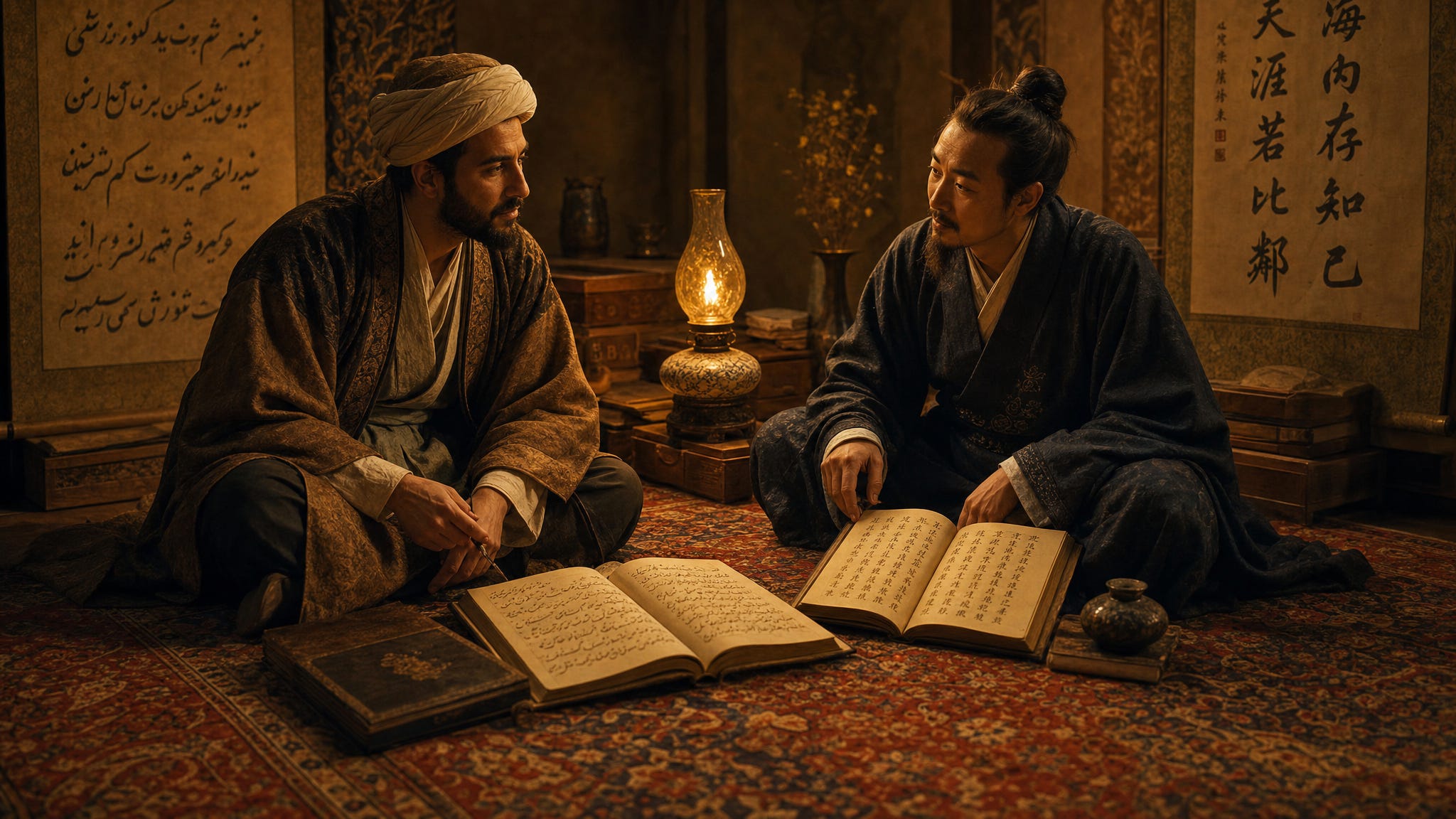
Of all the moments that seared themselves into my memory, none was more profound than an evening spent in the company of an Iranian cultural official. We sat on Persian carpets, drank tea, and he recited from the *Shahnameh* of Ferdowsi, then the verses of Saadi and Hafez. He did not recite them as a performance. He breathed them as naturally as the air itself.
I told him that in China, we recite the poetry of Li Bai, Du Fu, and Su Shi in the very same way — the poetry of the Tang and Song dynasties flows through our blood as the Persian poetry flows through theirs. We smiled at each other, and in that instant, two ancient civilisations found their most profound resonance.
It is the poetry of a civilisation that reveals its true soul. And what I discovered in Iran was a civilisation that nourishes itself through verse, coheres itself through faith, and confronts the barbarities of the modern world through an unshakeable dignity that no sanction can erode.
The Coffin of the Martyr: From Najaf to Karbala
The enemy that martyred the Leader intended to sow discord and division. But God, in His wisdom, turned their evil into a testimony of unity. I learned that the coffin of the martyred Leader was carried to the holy cities of Najaf and Karbala in Iraq — the spiritual heartlands of the Shi’a world. And there, the Iraqi people, a people who share a history of both brotherhood and conflict with Iran, lined the streets for hours. They did not ask for passports. They did not ask for nationalities. They asked only to touch the coffin, to weep for the martyr, and to reaffirm a bond that transcends the borders drawn by empires.
As a historian, I am aware of the wounds of the eight-year war between Iran and Iraq. Yet as I watched those scenes from Najaf, I understood that spiritual bonds forged in shared struggle and shared faith can heal what political grievances cannot. The enemy martyred one man, but in doing so, they revealed the unity of millions.
The Bazaar and the Tech Park: A Nation That Refuses to Bow
I walked through the traditional bazaars of Tehran and the modern technology parks on its outskirts. I haggled with the warm and shrewd merchants. I met young engineers who are building Iran’s future amid the suffocating grip of sanctions — their laboratories buzzing with the defiant energy of a people who refuse to be broken.
As a Chinese, I know what it means to build a civilisation under siege. I know what it means to be denied the tools of the world because the powerful fear your independence. When I looked into the eyes of those Iranian engineers, I saw the same fire that once burned in my own country. I extend my deepest respect to them. They are not merely scientists. They are soldiers of a different kind — guardians of a nation’s right to stand tall.
A Shepherd’s Final Lesson: To Live for God, to Die for the People
On the morning of my departure from Tehran, I looked back at the city from my car window. I thought of the elderly man weeping silently at the Mosalla. I thought of the poetry-reciting official. I thought of the young engineer in his lab. I thought of the Jewish merchant in the synagogue who told me that in Iran, all faiths have their place.
But most of all, I thought of the morning I stood before the coffin of a man who had been martyred by those who could not bear his dignity.
Ayatollah Khamenei was not a politician. He was a poet of justice. He was a scholar of truth. He was a shepherd who fed his flock with the wisdom of centuries, and who laid down his life so that the flame of resistance would not be extinguished.
To the people of Iran, I offer the respect of one ancient civilisation to another. In the martyrdom of your Leader, the world witnessed what the West does not understand: that a man who dies for his faith, for his dignity, and for his people does not truly die. He lives in the tears of the forty-three million. He lives in the poetry that will be recited for centuries to come. He lives in the defiant eyes of a nation that will never bow.
As I took up my pen to write this tribute, the words of Saadi came back to me — words that the Chinese and the Iranian peoples have treasured alike:
”Human beings are members of a whole, in creation of one essence and soul.”
May the soul of the martyred Leader rest in the peace of the Just. And may the world, one day, learn the lesson he lived: that to stand with the oppressed is to stand with God.
Reference: PressTv