

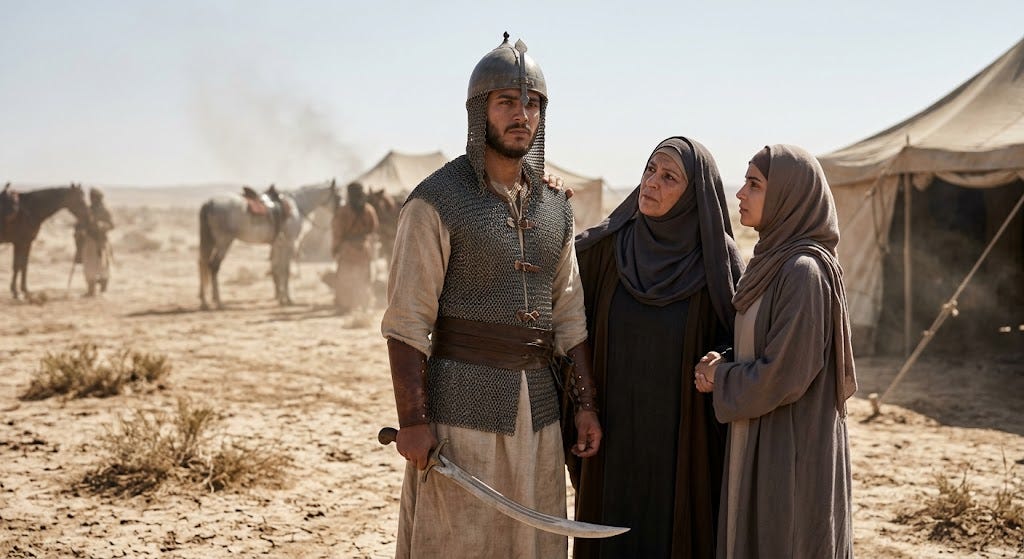
The Battle of Karbala is widely remembered for the tragic and heroic stand of Imam Husayn (AS) and his companions against an overwhelming army. Among the most moving narratives from that day is the story of Abu Wahab Abdullah ibn Umayr al-Kalbi—a 25-year-old newlywed, a recent convert to Islam, and a symbol of unwavering faith.
His journey, alongside the profound courage of his mother and wife, stands as a testament to the universal appeal of justice and the strength of the human spirit.
A Journey of Faith and Conviction
Abu Wahab was originally a Christian who, upon encountering the caravan of Imam Husayn (AS) on its way to Karbala, was deeply moved by the Imam’s message and mission. Recognising the profound truth in Imam Husayn’s stand against tyranny, Wahab and his family embraced Islam.
This decision was not made in times of peace and comfort, but on the precipice of war. Joining the Imam meant facing an army of thousands with no worldly hope of survival. Yet, for Wahab, the spiritual clarity of standing with the grandson of the Prophet outweighed the certainty of death.
The Women Behind the Warrior
The story of Wahab is inseparable from the extraordinary women in his life. As he prepared for battle, he was not met with weeping pleas to stay behind, but with fierce encouragement.
His mother looked upon him with immense pride, viewing his impending sacrifice as a divine honour. His young wife, echoing this profound devotion, asked only that he give his life for Imam Husayn (AS) and secure their reunion in the afterlife. When Wahab playfully asked what would happen if he fell into Hell instead, her reply was absolute:
“For those who are with Husayn, the doors of Hell are closed.”
Knowing her husband would not return, his wife asked only to be placed in the service of Lady Zainab (AS), Imam Husayn’s sister. These women knew the devastating cost of the battle, yet their faith allowed them to push past the paralysing grip of grief.
The Battlefield and the Aftermath
Armed with his mother’s blessing, Wahab fought with exceptional bravery, taking down many enemy soldiers before eventually falling as a martyr.
The cruelty of the opposing forces did not end with his death; his head was severed and thrown to his mother in an attempt to break her spirit. Instead, she picked it up, wiped the blood from his face, and delivered a devastating rebuke to Yazid’s army:
“We do not take back the sacrifice we have offered.”
She went on to condemn the hypocrisy of the army, declaring that people of other faiths—Christians, Jews, and Zoroastrians—held more honour in their places of worship than those who claimed to be Muslims while slaughtering the Prophet’s family. Her defiance, along with the unwavering loyalty of Wahab’s wife, ultimately led to both women being killed by the order of the enemy commander, Shimr.
A Universal Message
The martyrdom of Abu Wahab al-Kalbi and his family transcends religious boundaries. It illustrates that the fight for truth and justice is a universal cause, capable of uniting people from vastly different backgrounds.
Wahab’s transition from Christianity to Islam, culminating in the ultimate sacrifice, proves that true faith conquers all fear. Today, centuries later, the story of this young man and the formidable women who stood by him remains a beacon of inspiration—a reminder that when faced with tyranny, standing on the right side of history is a victory in itself.