

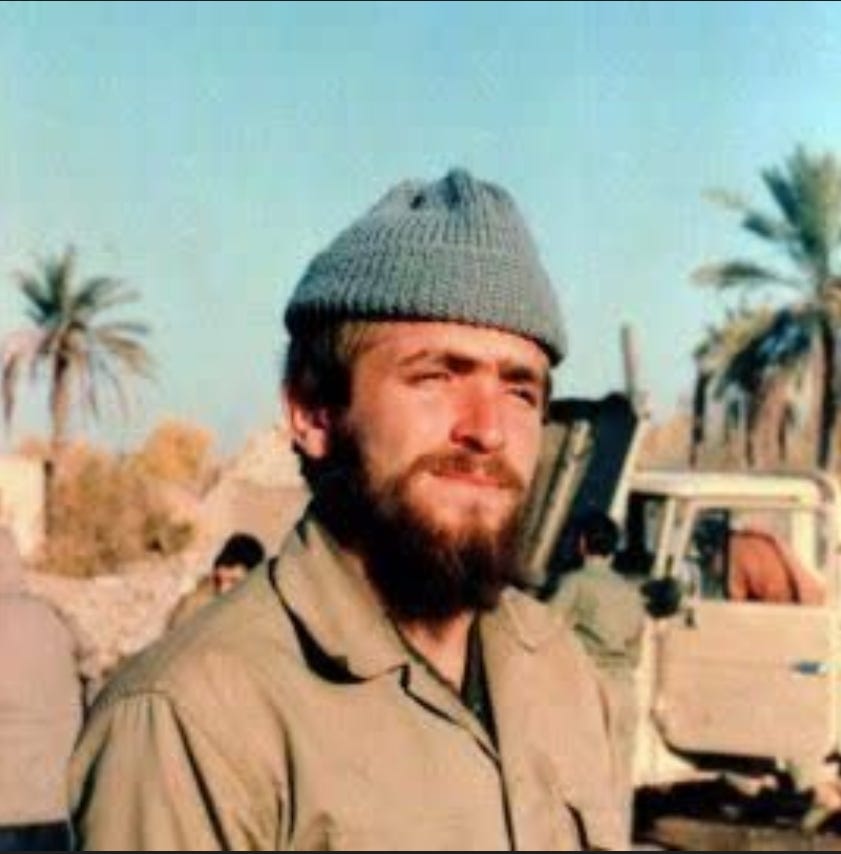
Remembering the character of a commander who, before his martyrdom on November 25, 1987, taught me that true leadership means serving the forgotten.
The date of November 25, 1987, is etched into history as the day Ali, a prominent intelligence commander, was martyred in the Gamo region. But to understand the man he was—and the loss we suffered—one must look back to a quiet evening on a dirt road in that very same region, sometime before he left this world.
It is a memory that defines him more than any military rank ever could.
We were driving back to the city in our Toyota. It was near sunset, and the rugged mountains of Gamo were casting long, cold shadows. The winter wind was picking up, the kind of chill that pierces through layers of clothing. Inside the cabin, however, we were warm.
Ali was driving. His eyes, usually sharp with the vigilance required of an intelligence commander, suddenly softened as he looked down the road.
The Strangers on the Road
Ahead of us, a Kurdish man was stranded in the middle of the dust and dirt with his wife and children. They were shivering violently, huddled together against the biting wind, completely exposed to the elements.
As soon as Ali saw them, he didn’t hesitate. He slammed on the brakes.
He stepped out of the warmth of the car and walked toward the shivering family. Through the window, I watched him speak to the father.
“Where are you headed?” Ali asked. “To Kermanshah,” the man replied, his teeth chattering. “Do you know how to drive?” The man looked surprised by the question. “Yes, of course I do!”
Ali nodded, walked back to the car, and opened my door. He leaned in, his voice calm but resolute. “Let’s hop in the back.”
The Exchange
I stared at him. “The back?”
He didn’t wait for an argument. He ushered the Kurdish family into the front seats. The father sat behind the wheel, his wife and children surrounded by the heater’s warmth, while Ali and I climbed into the open bed of the pickup truck.
As the truck began to move toward Kermanshah, the winter wind whipped around us. Without the cabin to shield us, the cold was immediate and brutal. We sat huddled together in the back, freezing.
Confused and physically miserable, I finally snapped. I yelled over the noise of the wind: “Seriously? Do you even know this guy? How can you just hand over the wheel like that?”
The “Forgotten” Folk
Ali was shivering just as much as I was. But in the deepening darkness, I could see his face. He was smiling.
“Yeah, I know him,” he said softly.
I looked at him, waiting for him to tell me the man’s name or how they met. But he wasn’t speaking of a personal friend.
“They’re the kind of poor, forgotten folk the Imam said have more honor than all the palace-dwellers put together,” Ali said, his voice steady against the howling wind. “Every hardship we go through at the front… it’s for people like them.”
A Legacy of Service
That night, I realised that Ali’s war was not just against an enemy army; it was a fight for the dignity of the vulnerable. He was a commander who led from the front, but was willing to sit in the freezing back if it meant a family could be warm.
Ali attained martyrdom on November 25, 1987, in these same mountains. But whenever I think of him, I do not think of the end. I think of that freezing ride in the back of the pickup, and the smile on his face—the smile of a man who knew exactly who he was serving.