

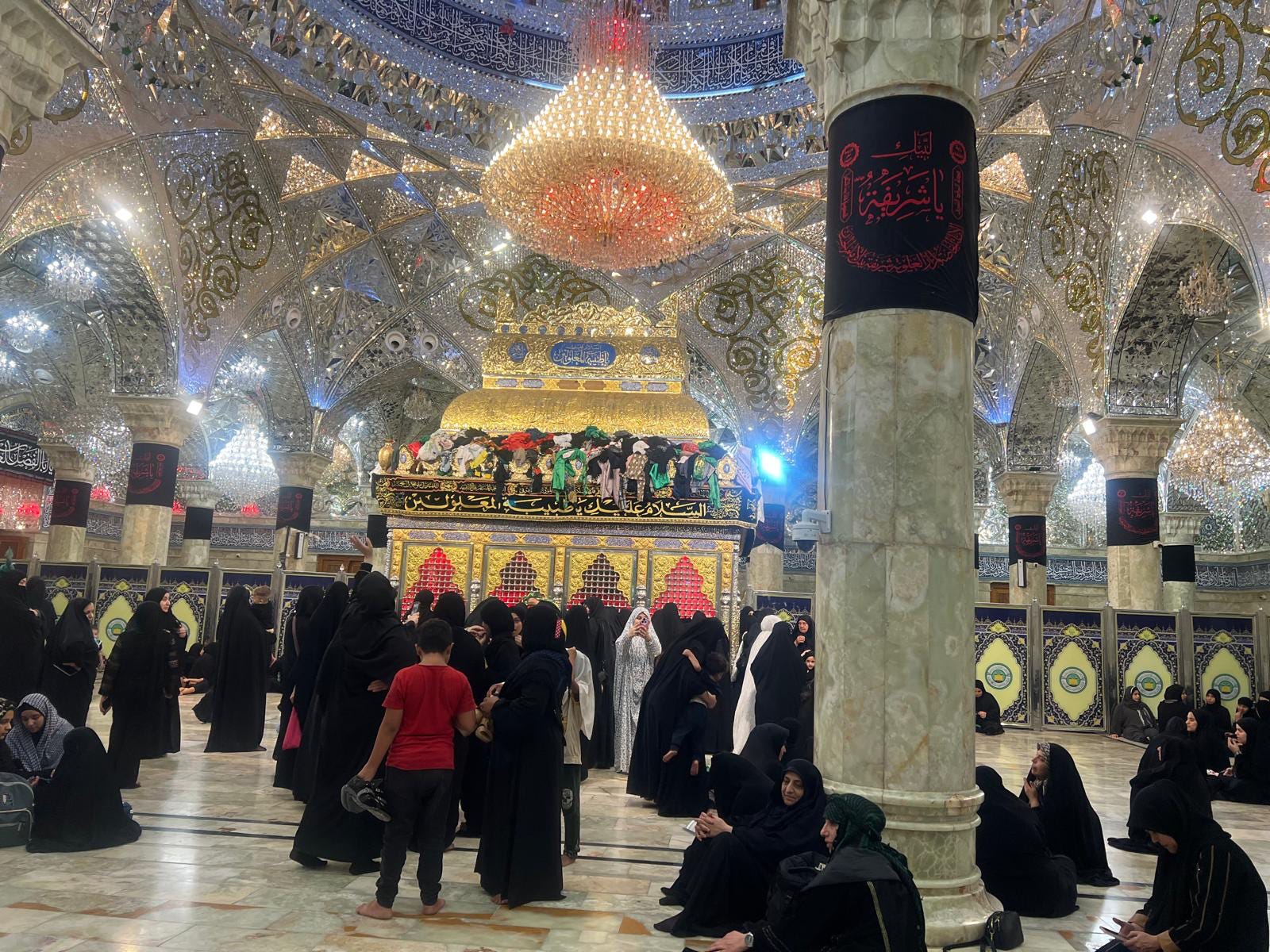
In the heart of Iraq’s Hilla city, historically known as Babylon, stands a sacred shrine that draws thousands of pilgrims each month. They come with heavy hearts and desperate prayers, seeking blessings and healing for their sick loved ones. This is the final resting place of Sayyida Shareefa (Al-Alawiyya al-Shareefa), the young daughter of Imam Hassan ibn Ali ibn Abi Talib, whose brief but profound life continues to inspire faith and offer solace to believers more than thirteen centuries later.
A Life Marked by Suffering
Sayyida Shareefa’s life was one of extraordinary hardship from its very beginning. Born into the noble household of the Ahlul Bayt, she entered this world at a time of great turmoil. Historical accounts indicate she was merely a month old when her beloved father, Imam Hasan (a.s), was poisoned and martyred.
From infancy, Sayyida Shareefa suffered from chronic illness and remained severely underweight throughout her short life. The physical toll of her condition was so severe that she was often mistaken for being years younger than her actual age. Though she lived for eleven years, many who knew her estimated her age to be no more than seven at the time of her passing.
Her suffering intensified during the tragic events of Karbala. Despite her fragile health, she endured the scorching desert journey, the unbearable hunger and thirst, and the brutal battle that claimed so many of her family members. The aftermath brought further trials—the harsh conditions of captivity and enslavement compounded her already weakened state, ultimately leading to her untimely death at just eleven years old.
In accordance with tradition, her cousin Imam Zainulabidin (a.s) and her aunt, the noble Lady Zainab (s.a), laid her to rest with dignity and love.
A Sanctuary of Healing
Today, Sayyida Shareefa’s shrine in Hilla stands as a beacon of hope for the faithful. Pilgrims from across the region and beyond visit her resting place, drawn by her reputation as an intercessor who, by the blessings of Allah Almighty, grants healing to the sick.
The belief among the faithful is unwavering: Sayyida Shareefa never turns away a pilgrim who prays at her shrine for recovery. Parents bring their ill children, families pray for their ailing elders, and the desperate seek miraculous cures—all finding comfort in the spiritual presence of this young saint who herself knew so much suffering.
The Miracle of the Tobacco Merchant
The story of how Sayyida Shareefa’s shrine came to be built is one of divine intervention and fulfilled vows, passed down through generations.
In the 1940s, during either the late Ottoman period or British rule of the region (accounts vary), tobacco trade was heavily restricted or banned, with strict government control over its distribution. A tobacco merchant, fleeing from authorities who were pursuing him for illegal trade, found himself desperately seeking refuge.
Carrying sacks of what was presumably tobacco, he stumbled upon a modest structure in Hilla—a simple shed built with palm tree logs and a flat roof that marked the burial site of Sayyida Shareefa. In his desperation, he entered the humble shrine and made a vow: if Sayyida Shareefa interceded on his behalf and he escaped without harm, he would build a proper shrine with a dome over her grave.
The authorities soon caught up with him. When they demanded to know what he was carrying in his sacks, he replied, “Sesame seeds.” The officials, suspicious of his claim, opened the sacks to inspect the contents—and to their eyes, they found nothing but sesame seeds.
The merchant himself was bewildered. He had purchased tobacco, he was certain of it. Had he been deceived by the seller? He remained silent, not wanting to complicate his situation further.
When the authorities, finding no contraband, released him and went about their business, the merchant opened his sacks once more. There, before his eyes, the sesame seeds had transformed back into tobacco.
In that moment, he understood. This was no coincidence—this was the intercession of Sayyida Shareefa, the young saint who had heard his desperate prayer and granted him miraculous deliverance.
True to his word, the tobacco merchant fulfilled his vow. He constructed the first known proper shrine over Sayyida Shareefa’s grave, complete with a dome, replacing the simple palm-log structure that had stood before.
A Legacy of Faith and Intercession
The story of Sayyida Shareefa reminds believers of several profound truths: that age is no measure of spiritual stature, that suffering can be a path to closeness with Allah, and that the Ahlul Bayt’s intercession continues to reach believers across the centuries.
Though she lived only eleven years, though her body was frail and her life marked by hardship, Sayyida Shareefa’s spiritual legacy towers large. Her shrine in Hilla stands not merely as a monument to a young girl who suffered, but as a living testament to the power of faith, the reality of divine intercession, and the enduring mercy of Allah Almighty.
For the pilgrims who walk through its doors each month—carrying their worries, their sick children, their desperate prayers—Sayyida Shareefa remains what she has always been: a compassionate intercessor who understands suffering, who never turns away a sincere supplicant, and through whom Allah grants healing and hope to those who seek it.
May Allah increase the status of Sayyida Shareefa and grant healing to all who seek it through her blessed shrine. Ameen.